

Strikeout props are the most model-friendly market in baseball. Both sides of the matchup are measurable, the outcome is a count you can price, and the sportsbook line usually sits within a strikeout of where a good projection lands. That last part is the catch: when the market is that close, the edge comes from getting the small things right. How many batters the pitcher will face, how the lineup in front of him strikes out, and what you are paying for the over. This guide is part of our Sport Guides series; the MLB player props guide covers the other markets.
Strikeouts = batters faced × strikeout rate
Every strikeout projection starts from two numbers:
- Batters faced. How many hitters the starter will see before he leaves. This depends on his pitch count, his efficiency and his manager.
- Strikeout rate. The share of those hitters he strikes out, adjusted for the lineup he is facing.
Multiply them and you have the average: a starter who faces 24 batters and strikes out 25% of them averages 6 strikeouts. The line is a different question. Over 5.5 needs 6 or more, and an average of 6 does not mean 6 or more half the time. Treat each batter as a chance at a strikeout and you can work out the probability of every count, which is what the charts below do. The Poisson calculator gives a quick version of the same idea from just the average.
Use strikeout rate per batter faced, not strikeouts per nine innings. K/9 rises for a pitcher who allows a lot of baserunners, because he faces more hitters per inning, so it overstates strikeout skill exactly when it should not.
The leash matters as much as the arm
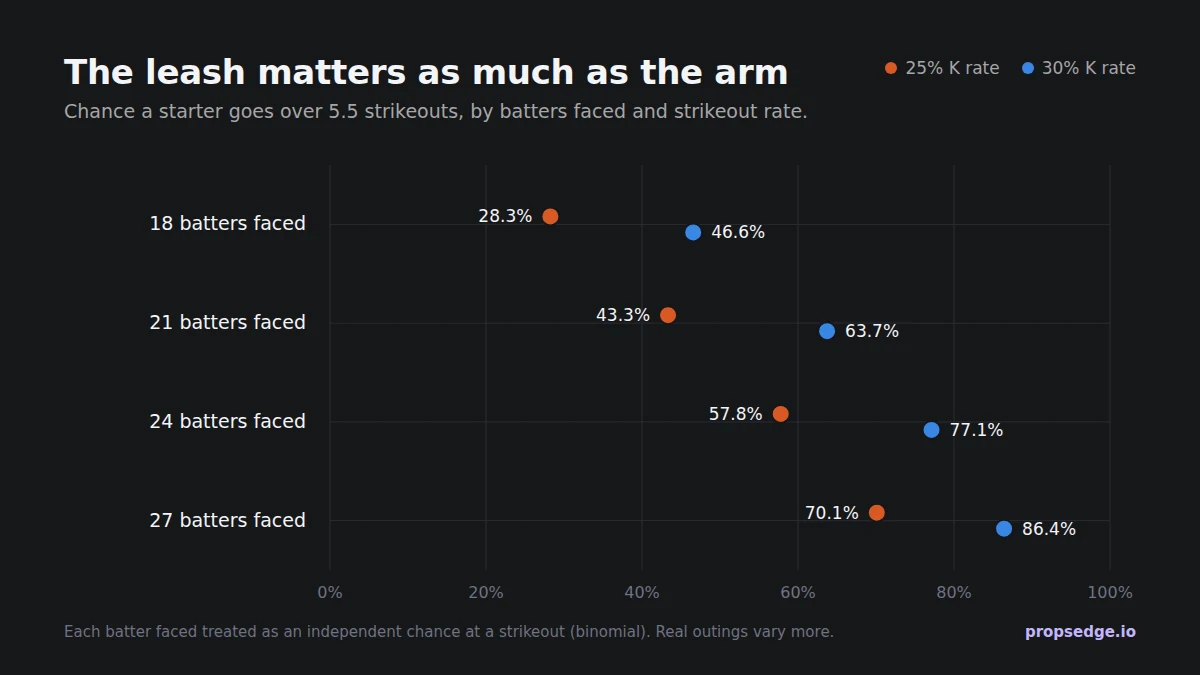
A 25% strikeout pitcher who faces 24 batters goes over 5.5 57.8% of the time. Cut him to 21 batters, three fewer, and it drops to 43.3%. That three-batter difference moves the over from a good bet to a bad one, and it is decided by things that have nothing to do with how sharp his stuff is:
- Pitch count. Check his last few starts. A pitcher coming back from injury or on a managed workload may be capped well short of a normal outing.
- Efficiency. A pitcher who runs deep counts and walks hitters reaches his pitch limit sooner, so he faces fewer batters.
- The manager. Some pull starters before the third time through the order no matter how they are pitching. Others ride a hot starter.
- The game. A blowout either way can end a start early. A rain delay can end it before it starts.
Most of the time a pitcher's season-average batters faced is a reasonable starting point, but the last three or four starts tell you more about his current leash than his April outings do.
Adjust for the lineup
A pitcher's strikeout rate is an average over every lineup he has faced. Tonight he faces one. A lineup full of high-strikeout hitters raises his expected rate, a contact lineup lowers it, and handedness matters: a right-hander with a wipeout slider will strike out right-handed hitters more often than left-handed ones, so the number of lefties in tonight's lineup changes the projection.
Wait for the confirmed lineup when you can. A team resting two of its high-strikeout regulars in a day game can take a strikeout or more off the top of the projection, and the line may not move.
The home-plate umpire matters at the margins. A wide strike zone helps strikeout overs and a tight one helps unders, but the effect is smaller than the pitcher, the lineup or the leash. Use it to break a close call, not to make one.
Half a strikeout is a big move
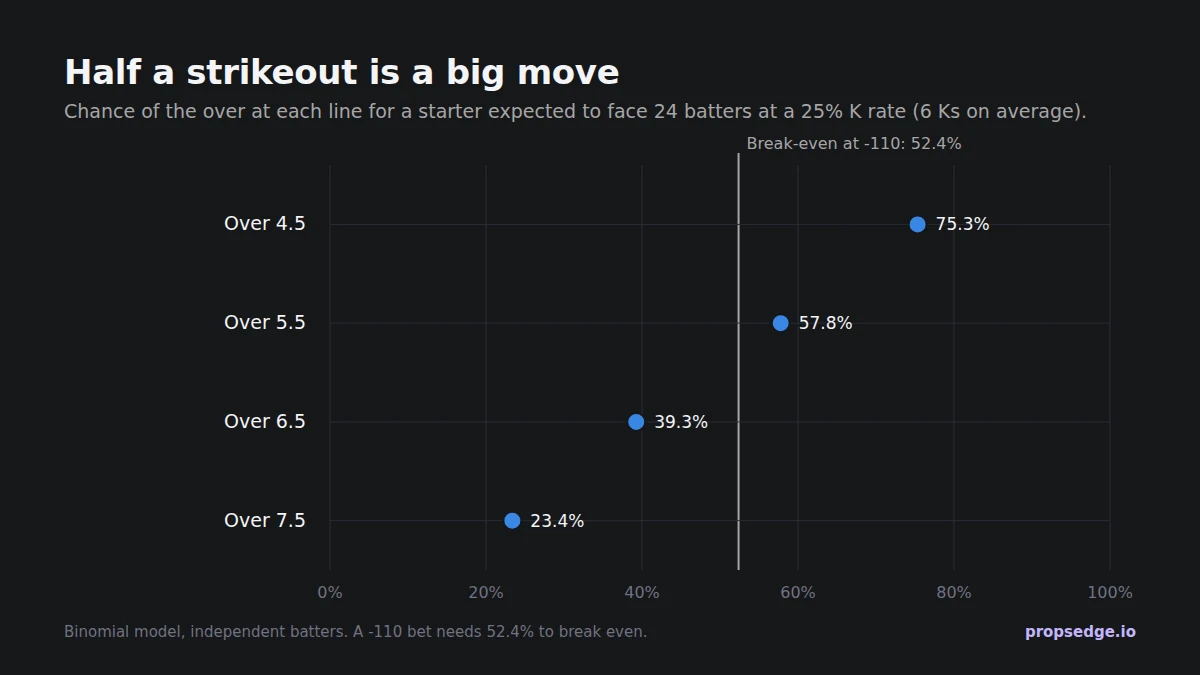
For a pitcher averaging 6 strikeouts, the over at 5.5 hits 57.8% of the time and the over at 6.5 hits 39.3%. That one step is worth almost 19 percentage points, far more than the difference between -110 and -150. So:
- Shop the number before the price. One book at 5.5 and another at 6.5 are different bets. The best price at the wrong line is still the wrong bet.
- Use alternate lines when your projection sits between two numbers.
- Pick'em apps often post a strikeout line half a strikeout away from the sportsbooks. That is where the softest strikeout props are, and the MLB Demons & Goblins sheet shows which PrizePicks lines the books price at the same number.
Strikeout overs come juiced
Bettors like overs, and books price strikeout overs accordingly. An over at -140 with the under at +115 is a common shape. The two prices imply 58.33% and 46.51%, a 104.84% book, and the fair price on the over is 55.64% once the margin is removed. The devig calculator does this in one step.
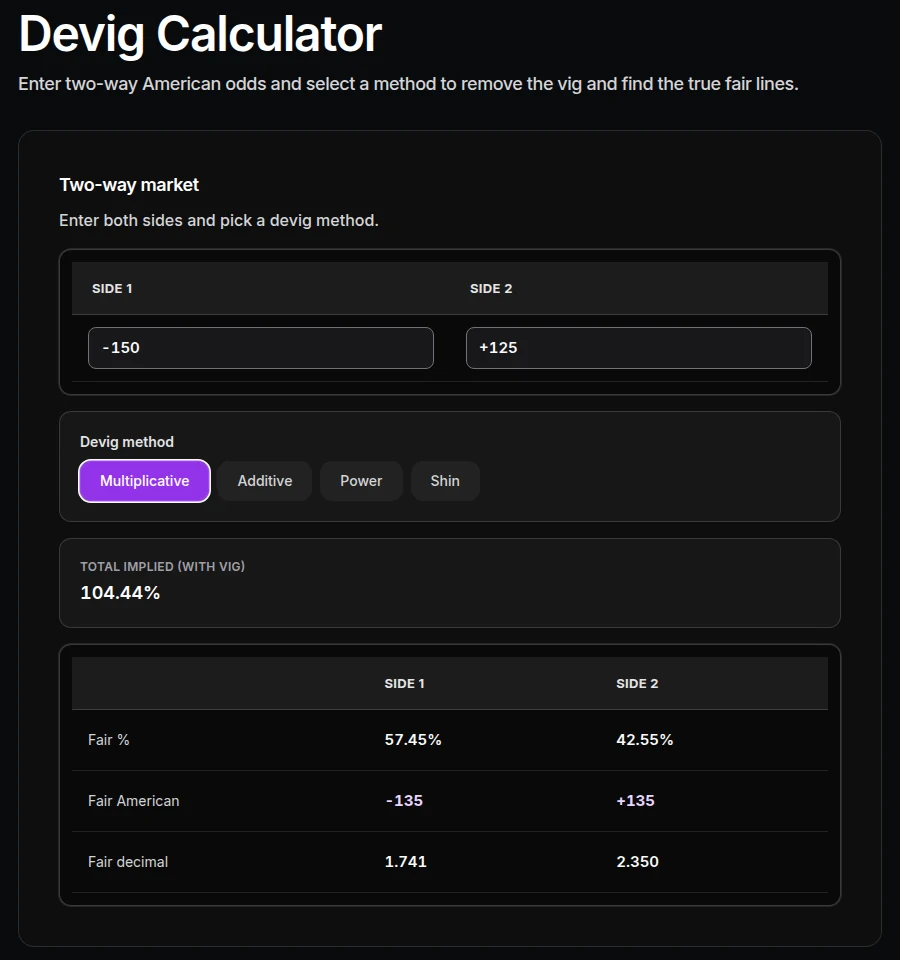
Remove the margin from both sides before you compare a price with your projection.
Run the pitcher from the chart through it. At 57.8%, an over at -110 returns about 10 cents per dollar. The same over at -140 loses about a cent per dollar. Same pitcher, same projection, opposite answer. Paying -140 for a strikeout over needs a projection well above the line, not just above it.
What changes in the postseason
October changes the leash more than anything else. Managers use their bullpens far more aggressively in the playoffs, starters are often pulled before the third time through the order, and an off day between games means the best relievers are fresh. The result is that the batters faced number behind a regular-season strikeout line can be too high for a playoff start, which favors unders, especially on starters whose average depends on going deep into games.
Three more things to check in a playoff series:
- Rest. A starter on short rest, or a regular-season starter used in relief, comes with a shorter leash.
- Lineups are at full strength. No resting regulars, so the lineup adjustment uses the team's best nine.
- Openers and bulk relievers. If a team announces an opener, the listed starter may face only a handful of batters. Read your book's rules: most void a pitcher prop if the listed pitcher does not start, but a pitcher who starts and leaves after one inning settles as a loss on the over.
The routine
- Batters faced: last three or four starts, adjusted for rest, pitch count and the manager.
- Strikeout rate: per batter faced, adjusted for the confirmed lineup and its handedness.
- Probability: turn the average into a chance of clearing the line, not just a projected total.
- Price: devig the market, then compare. Shop the line first and the price second.
- Stake flat and log every bet with your projection, so you can check your batters faced and strikeout rate against what happened. The bankroll guide covers sizing.
Doing it in PropsEdge
The free Strikeout Props cheat sheet ranks the day's best strikeout matchups. Each starter gets a matchup score that combines his strikeout profile (K/9, whiff rate, chase rate and put-away rate) with the opposing lineup's strikeout vulnerability, including platoon splits and the hitters projected to start. A PropsEdge membership adds every starter on the slate, full arsenal breakdowns, the five most strikeout-prone hitters in each lineup, logs of each pitcher's last five starts, and strikeout prop odds compared across 15+ sportsbooks. The Park Factors sheet and Batter vs Pitcher sheet cover the rest of the matchup.
A strikeout prop is a bet on two numbers, and the one people skip, batters faced, is the one that decides most of them. Bet what you can afford to lose. If it stops being fun, stop. Help is free and confidential at 1-800-GAMBLER.
Cover photo: Eric Kilby, CC BY-SA 2.0, via Wikimedia Commons, color graded.


.jpg)