
A rebounds line looks like a bet on how hard a big man plays. Mostly it is a bet on two things he doesn't control: how long he is on the floor, and how many shots go up and miss while he is there. Every rebound starts as someone's miss. A player who grabs the same share of the misses he always does will still swing several rebounds from game to game, just because some nights there are more misses to grab. This guide is part of our Sport Guides series. The NBA player props guide covers minutes, usage and pace for every stat, and the threes guide works through the same method for shooters.
Start with minutes
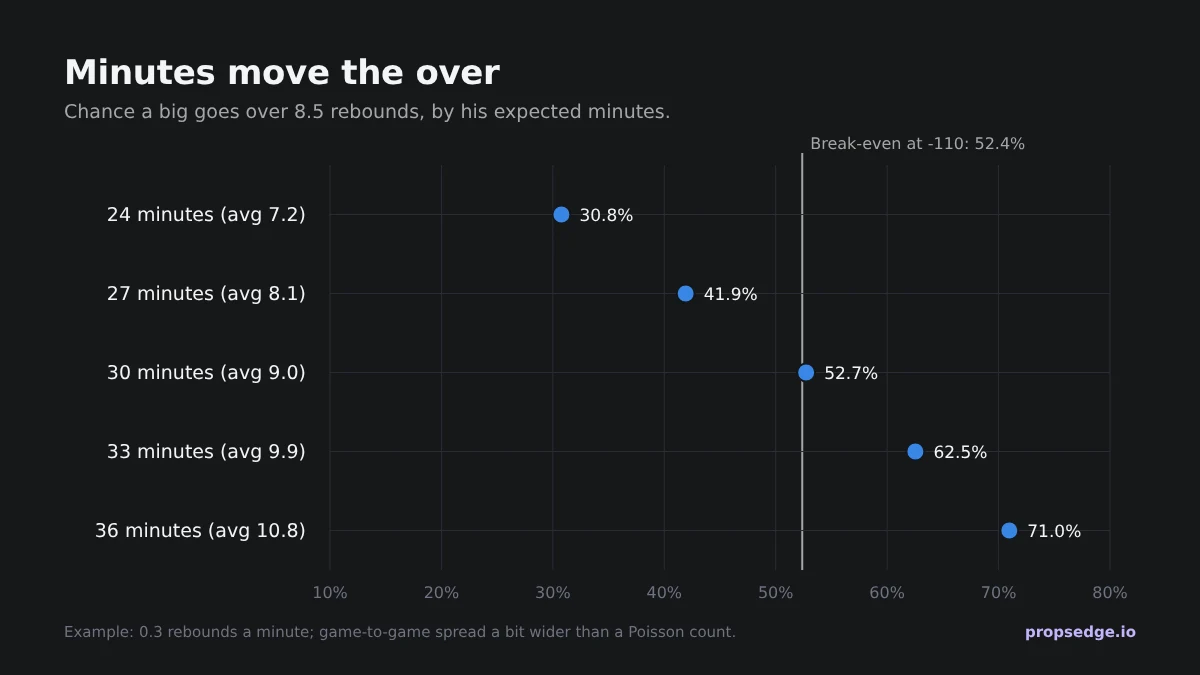
At the same 0.3 rebounds a minute, a big expected to play 24 minutes goes over 8.5 about 31% of the time, and one expected to play 36 minutes about 71% of the time. The -110 break-even sits right at 30 minutes. So the first question is how long he will play:
- The rotation. Check who is starting, who is out and how the coach has split the center minutes lately. A backup big who becomes the starter for a night can gain 10 minutes.
- Foul trouble. Bigs pick up fouls guarding the rim. A player who often sits early with two fouls loses minutes on nights the officials call it tight.
- The spread. A blowout takes starters out of the fourth quarter. A big spread is a reason to shade a starter's minutes down, whichever side he is on.
- Rest. The second night of a back-to-back is where minutes restrictions and surprise rest days show up.
Then rebound chances
Once you have minutes, the next question is how many chances he will get. A rebound chance is a miss that comes down near him. Two things set how many there are:
- How many shots the opponent misses. Rebounds come from misses, and most of them are defensive: roughly three in four rebounds in an NBA game go to the defense. An opponent that shoots poorly, or takes a lot of long threes that bounce away, creates more defensive rebounds for everyone. A fast pace and a high total add shots on both ends.
- Who he shares the glass with. A second big on the floor takes chances away. When a strong rebounder on his own team is out, his chances usually go up; when one returns, they go down. Guards who crash the boards take some too.
The PropsEdge player page shows this directly: on a rebounds chart, the grey "chances" overlay shows his rebound chances in each game under the bar of rebounds he grabbed. A game where he had 6 rebounds on 15 chances tells you something different from 6 on 8. The first is a player who got his usual looks and didn't convert; the second is a game with few misses near him. Only the second is a reason to expect fewer next time.
How the spread of outcomes looks
Rebounds swing more than most people expect. For a big projected at 9.6 rebounds, he grabs 6 or fewer about 20% of the time and 13 or more about 20% of the time. Those are both normal games, not outliers. A short run of high or low totals moves his recent average a lot without telling you much, so check his minutes and his chances before you trust it.
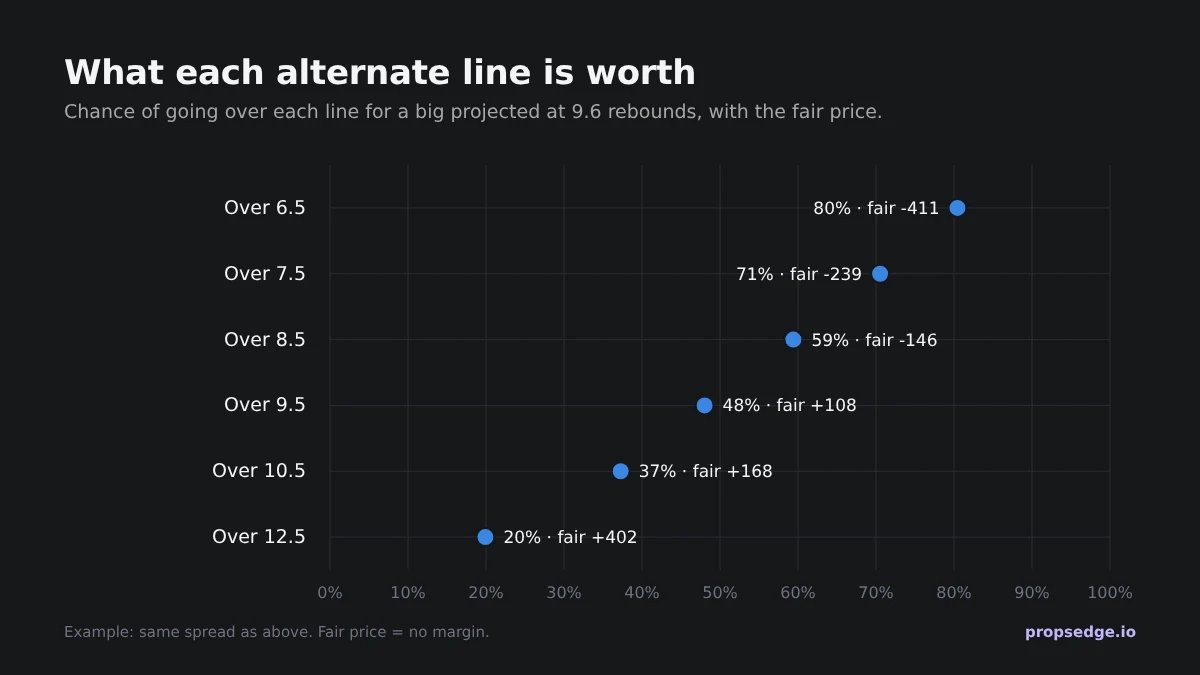
Price every rung from the same projection. For this big, over 8.5 is fair at -146 and over 9.5 at +108, so the half-point between them is worth a lot: an over 8.5 at -120 is an edge, while an over 9.5 at -110 is not. Further out, over 12.5 is fair at +402. Alternate lines carry their own margins, so compare each one with the fair price instead of assuming. The odds converter turns any price into its implied chance, and the EV calculator shows what the gap is worth.
On pick'em apps a pick on a two-pick PrizePicks Power play needs to hit about 57.7% of the time to break even, more than a -110 bet's 52.4%. In the example, the over 8.5 at 59% clears that bar, but only just.
How a rebound is counted
- The player who gains control gets it. A big who tips the ball to a teammate doesn't get the rebound; the teammate who catches it does. Players who tip out a lot of offensive boards can have low rebound totals for the effort they put in.
- Team rebounds count for nobody. A miss that goes out of bounds, or a missed first free throw, is credited to the team, not to a player.
- Overtime usually counts, and if he is ruled out before the game the bet is usually void. Rules differ by book, so check yours.
The matchup, on the sheet
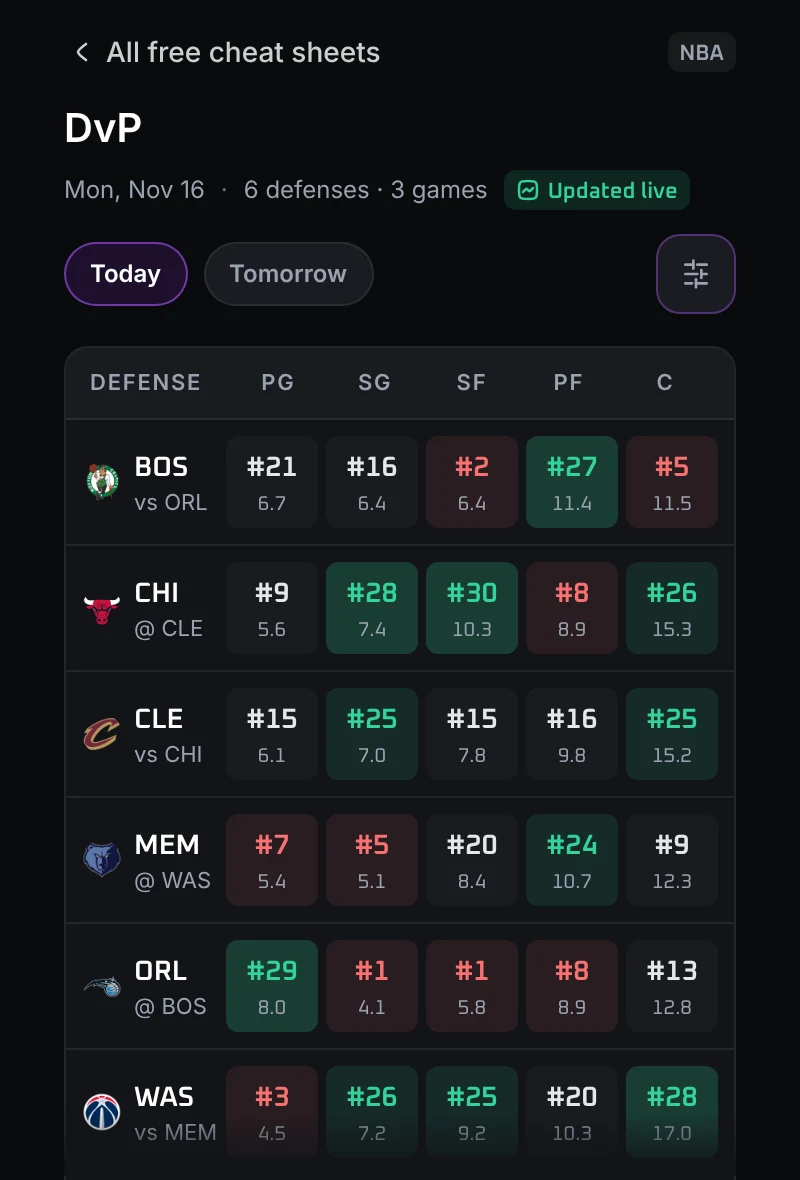
The free NBA Defense vs Position sheet shows what each defense allows to each position, by stat and window. With rebounds selected for today's games, Washington has allowed 17.0 rebounds a game to centers, against 11.5 for Boston. Part of that gap is Washington's own misses on the other end, and part is who they have faced, so treat it as a nudge to your chances, not a bet on its own. The defense vs position guide explains how far to trust numbers like these.
- Shop the line. Books often post different rebound lines for the same player. The free NBA Line Shopping sheet flags props where one book is paying meaningfully more than the rest, and the devig calculator strips the margin from a two-sided price.
- Shortlists. The free NBA Soft Spots sheet lines posted props up against the softest defenses for that position and stat, and NBA Prop Streaks shows who has cleared his current line most often lately. Both are places to start, not bets.
The routine
- Minutes first, from the rotation, injuries, foul trouble, the spread and rest.
- Rebound chances, from the opponent's misses, pace and who else is on the glass.
- Projection to probability at the main line and every alternate line.
- Price, shopped across books and checked line by line.
- Stake flat. In the example, a normal game lands anywhere from 6 to 13. The bankroll guide covers sizing, and the variance guide explains why good bets still lose often.
Doing it in PropsEdge
The projections board shows every player's rebounds line with our projection, the line movement and the best price across sportsbooks, and the player page's rebounds chart shows his rebound chances game by game. The free NBA cheat sheets above cover the matchup, the streaks and the price. A PropsEdge membership unlocks every row of every sheet.
Rebounds are a forecast of other players' misses as much as his own effort. Bet what you can afford to lose. If it stops being fun, stop. Help is free and confidential at 1-800-GAMBLER.
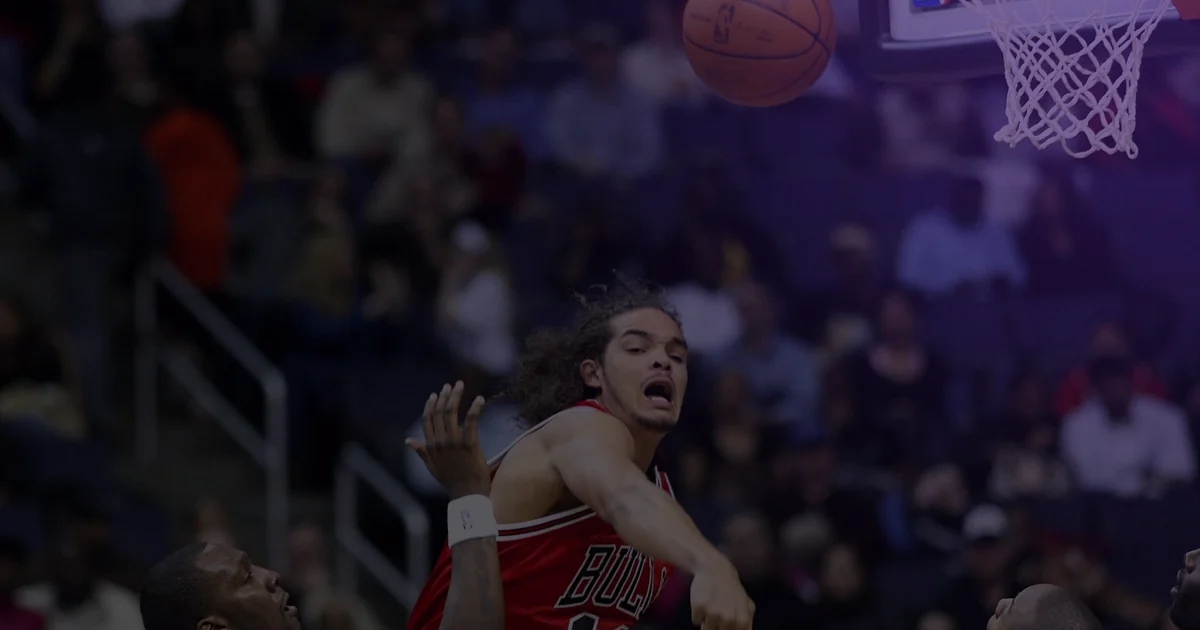
Cover photo: Joakim Noah fighting for a rebound, Chicago Bulls at Washington. Keith Allison, CC BY-SA 2.0, via Wikimedia Commons, cropped and color graded.