
Every pick'em app sells the same thing: choose some players, pick a side, get a multiple. The multiples are not the same, the lines are not the same, and the difference between a slip that loses slowly and one that wins slowly is usually which app you put it on. This post is the comparison, with the math shown so you can rerun it when the ladders change (they do, often, and by state). It sits in our How to Win series next to the full PrizePicks and Underdog guides.
The one calculation that compares everything
An app's payout only means something next to the hit rate it needs from each leg. For n legs that each hit with probability p:
- A slip that pays only when perfect returns pⁿ × multiplier per dollar.
- A slip with a one-miss consolation adds n × pⁿ⁻¹ × (1 − p) × (one-miss payout).
- A two-miss consolation adds the matching term.
The break-even hit rate is the p where the total equals 1. That single number is how you compare a 6x three-pick to a 2.25x/1.25x three-pick Flex, or either of them to a -110 sportsbook line (break-even 52.4%). The parlay calculator does the arithmetic for any ladder; the EV calculator tells you what a given hit rate is worth on it.
PrizePicks vs Underdog, same slips, side by side
Payouts at the time of writing for standard picks with no promotions:
| Slip | PrizePicks | Break-even | Underdog | Break-even |
|---|---|---|---|---|
| 2 picks, perfect only | 3x | 57.7% | 3x | 57.7% |
| 3 picks, perfect only | 5x | 58.5% | 6x | 55.0% |
| 4 picks, perfect only | 10x | 56.2% | 10x | 56.2% |
| 5 picks, perfect only | not offered | 20x | 54.9% | |
| 3 picks, one-miss pays | 2.25x / 1.25x | 59.1% | see app | |
| 4 picks, one-miss pays | 5x / 1.5x | 56.9% | see app | |
| 5 picks, two misses pay | 10x / 2x / 0.4x | 54.3% | see app | |
| 6 picks, two misses pay | 25x / 2x / 0.4x | 54.2% | see app |
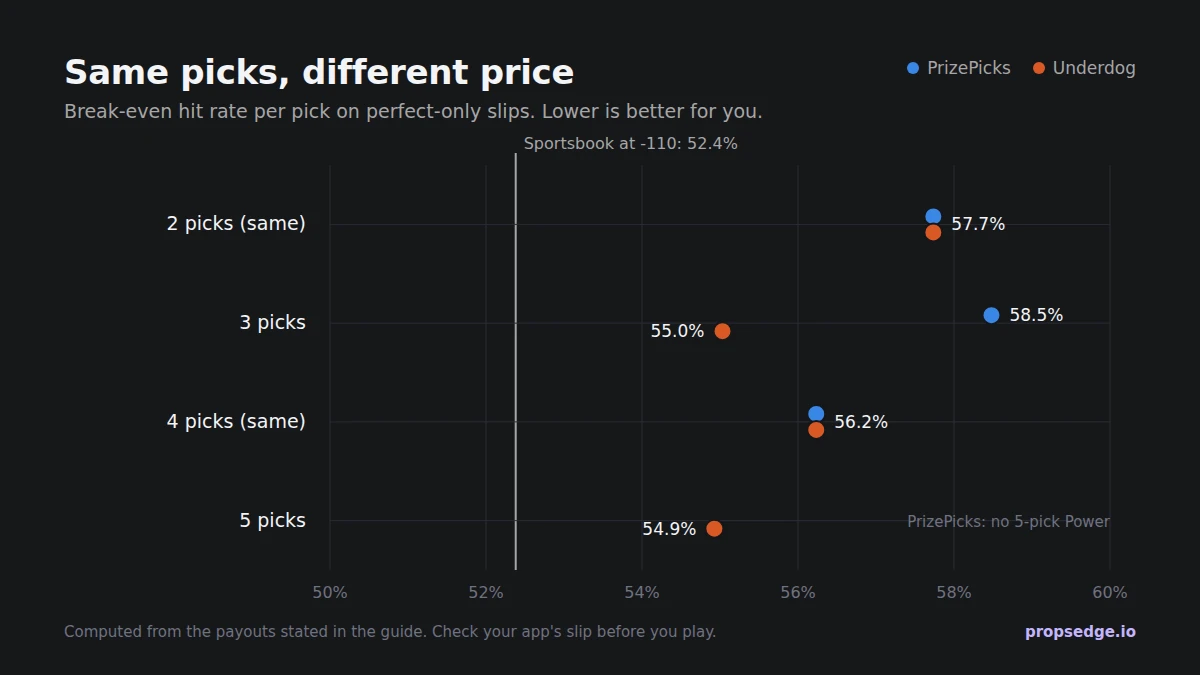
Underdog's Flex ladder changes more often than its Standard one and depends on the legs you choose, so read it off the slip screen and run it through the calculator rather than trusting any table, this one included.
What the comparison says:
- Three strong picks belong on Underdog. 6x at 55.0% beats PrizePicks' 5x at 58.5% by a wide margin. Same picks, same risk, one extra unit of payout.
- Two picks and four picks are a wash. Identical multiples, identical break-evens. Pick the app with the better line on your specific legs.
- PrizePicks' five- and six-pick Flex are the lowest break-evens on either app, at roughly 54%. They are also the slips where you most often collect a consolation rather than the headline number; a six-pick perfect slip at 54% per leg lands about 2.5% of the time.
- Underdog's 20x five-pick is a fair long shot at 54.9% but with no consolation; nineteen of twenty slips lose at that hit rate.
Reading any other app
Other pick'em apps run their own ladders and their own promotions, and all of them change. Some post one multiplier for the whole slip; others price each leg separately, with a lower multiple on picks they consider likely and a higher one on picks they consider unlikely, which is closer to how a sportsbook prices. The method does not change: read the multiplier the app displays for the exact slip you built, compute its break-even, and only submit if your legs clear it with margin. If an app will not tell you the payout until after you pick, that is a reason to pick somewhere else.
Two things are true on every app:
- Modified picks change the ladder. PrizePicks cuts the multiple on picks it flags as easy and raises it on hard ones; other apps do the equivalent with per-leg multipliers or "boosts". Easy is priced in. A 70% pick at a reduced multiple can be worse than a 58% pick at full multiple; run the number.
- A scratched player voids the leg, and the slip is re-rated at the smaller size. Payout shrinks; the slip rarely dies.
The thing that beats every ladder: the line
No ladder is generous enough to pay a coin flip. All of them pay a 58% to 60% proposition. The only reliable way to find a 58% proposition on a pick'em app is to find a line the sportsbooks disagree with:
- Sportsbooks price player props against sharp money all day. Pick'em apps post one number and move it less often.
- When the app's number sits away from the book consensus, the book is usually right, and the side the books favor at the app's number is your pick.
- The size of the gap decides whether it is a pick at all. A half-point on rebounds is noise; five receiving yards, three points, or an anytime-TD price that devigs above 58% is a play.
PropsEdge shows PrizePicks, Underdog and the other apps' lines beside 15+ sportsbooks on every player page, with the juice removed into a Chance% and a Value sort by the size of the gap. The Line Shopping cheat sheet surfaces the biggest NFL gaps each week with no account needed. Once you have the probability, this table tells you which app and which slip pays it best.
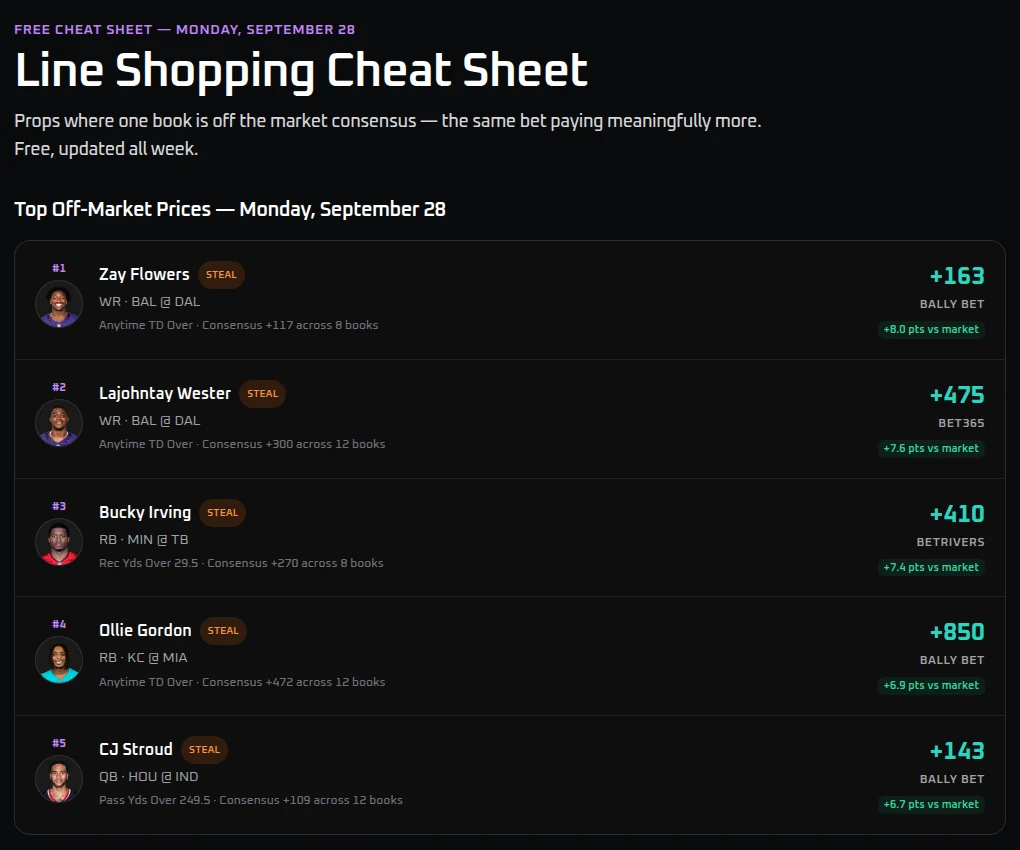
Screenshot of the free PropsEdge page, week of September 28, 2026. Prices move; open the page for today's.
A decision rule you can keep
- Screen the slate for gaps between app lines and book lines; devig the book price at the app's number with the devig calculator or read the Chance% column.
- Keep legs above 58% for perfect-only slips, 56% for slips with consolation payouts.
- Count the legs that qualify. Two or four: either app, whichever has the better line on those legs. Three: Underdog. Five or six with consolation: PrizePicks Flex. Five perfect-only: Underdog, at a stake you can lose twenty times in a row.
- Prefer legs that move together (a quarterback's yards with his receiver's; two players in one high-total game). The ladders price legs as independent; correlated legs hit together more often than they assume.
- Stake flat, one to three percent of your bankroll, every slip. The bankroll guide explains why the stake has to be identical on the slip that hits and the nineteen that do not.
Pick'em apps are not rigged and they are not generous. They are a payout table. Learn to read it and most of the slate stops looking like a bet at all, which is the point. Bet what you can afford to lose. If it stops being fun, stop. Help is free and confidential at 1-800-GAMBLER.
Cover photo: Baishampayan Ghose, CC BY-SA 2.0, via Wikimedia Commons, color graded.