


"Optimizer" sounds like software that finds winning slips. It is simpler than that and more useful: an optimizer is a set of rules for which legs deserve a place on a slip, which slip type fits them, and when to stop adding legs. You can run those rules by hand in ten minutes, and once you know them you can tell a good tool from one that just sorts by hit streak. This guide is part of our How to Win series and builds on the PrizePicks guide, which has the full payout table and break-even math. Every number below is computed from the payouts in that guide; if your app shows different payouts, the method still holds.
Step 1: price every leg, then rank
A slip is only as good as the probability of each leg, and the best public estimate of that probability is the sportsbook market. For every pick you are considering:
- Find the sportsbook line at the same number PrizePicks shows. If PrizePicks has 64.5 receiving yards and the books have 69.5, you want the books' price at 64.5, from an alternate line if needed.
- Remove the juice. -150 on the over and +125 on the under is a fair 57.45% over, not the 60% the -150 alone suggests. The devig calculator does it in one step.
- Prefer legs where several books agree. One book hanging a stale number is a weaker signal than four books sitting on the same price.
- Rank the legs by that devigged probability, highest first.
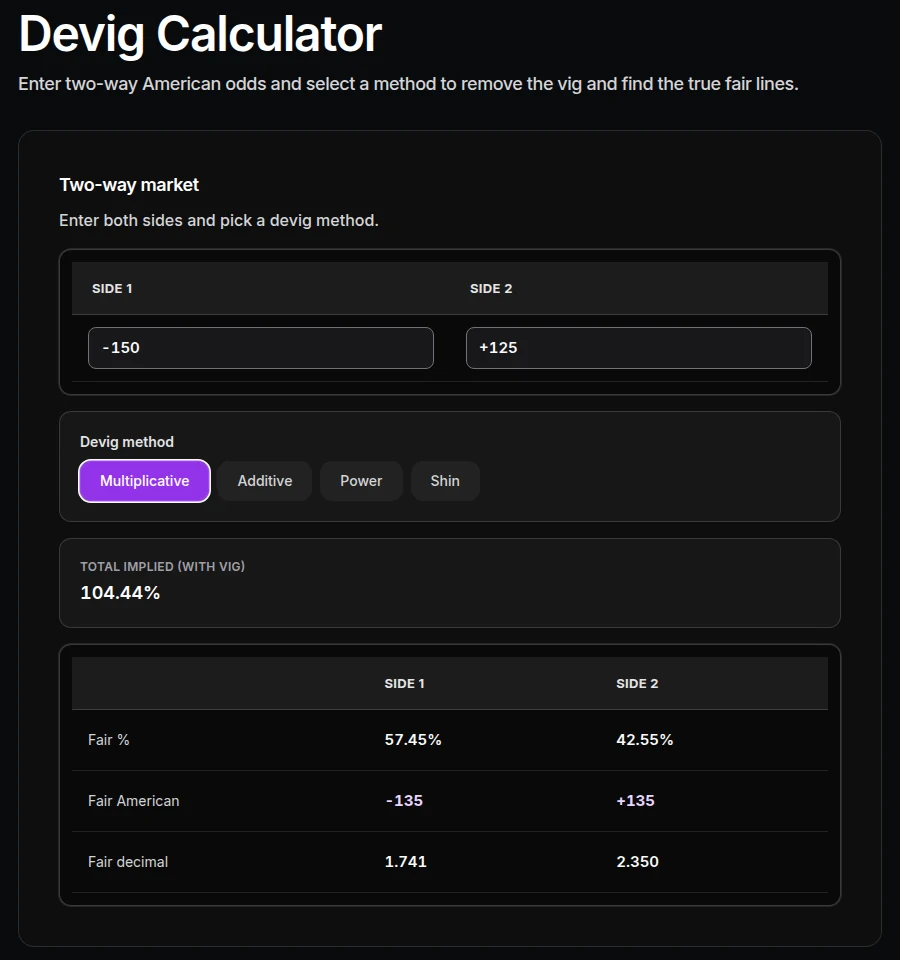
Devig first. -150 / +125 is a 57.45% proposition, which clears the Power 4 break-even of 56.2% but not the Power 3's 58.5%.
That ranked list is the whole input to an optimizer. Everything after this is arithmetic on it. The legs that make the list are almost always the ones where PrizePicks' number sits away from the books' consensus; the Line Shopping sheet and the line shopping guide show how often those gaps appear.
Step 2: match the slip type to the legs you have
The same legs can win on one slip type and lose on another, because each type breaks even at a different per-leg rate: Power 2 needs 57.7%, Power 3 needs 58.5%, Power 4 needs 56.2%. With every leg at a flat 58%:
| Slip | Break-even per leg | Return with 58% legs | Return with 55% legs |
|---|---|---|---|
| Power 3 (5x) | 58.5% | -2.4% | -16.8% |
| Power 4 (10x) | 56.2% | +13.2% | -8.5% |
| Flex 5 (10x / 2x / 0.4x) | 54.3% | +26.9% | +5.0% |
Three things fall out of that table. Power 3 is the worst small slip on the app, so a 58% leg that loses money there makes money in a Power 4. Flex 5 is the most forgiving slip when your legs are good but not great, because one or two misses still pay something: at 58% per leg it returns money about 65% of the time. And nothing fixes weak legs: at 55% every Power slip loses.
The practical rule: if your best legs are in the high 50s, play a Power 4 or a Flex 5 rather than a Power 3. If you only have two or three legs above 60%, a Power 2 or Power 3 is fine, and a fourth weak leg makes it worse.
Step 3: add a leg only if it clears the bar
This is the rule most slip builders miss. Adding a leg multiplies the payout and multiplies the chance of losing, so a new leg helps only if its probability beats the ratio of the two payouts:
New leg must hit more often than (old multiplier ÷ new multiplier).
On PrizePicks Power, going from 3 legs (5x) to 4 legs (10x) sets the bar at 5 ÷ 10 = 50%. Three 60% legs as a Power 3 return +8.0%. Add a fourth leg and the slip's return depends entirely on that leg:
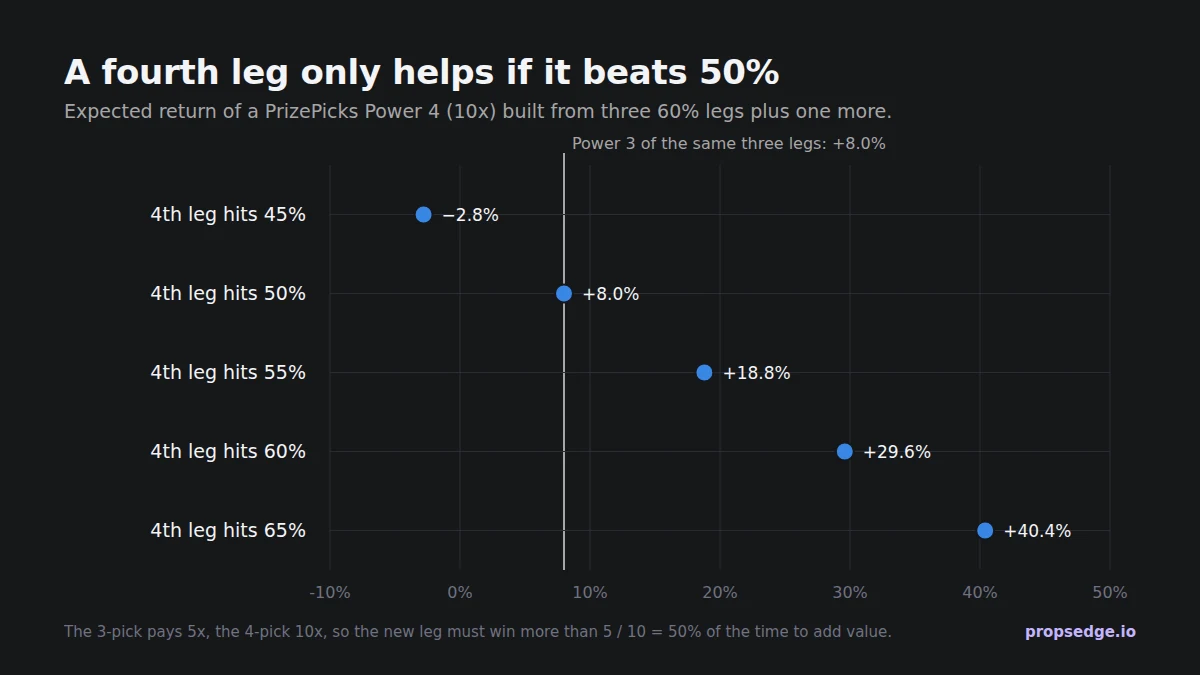
A 55% fourth leg lifts the return from +8.0% to +18.8%. A 45% one drops it below zero. Going from 2 legs (3x) to 3 legs (5x) is the expensive step: the bar is 3 ÷ 5 = 60%. Two 60% legs as a Power 2 return +8.0%; adding a 57% leg to make a Power 3 cuts that to +2.6%, even though 57% is a good pick on its own.
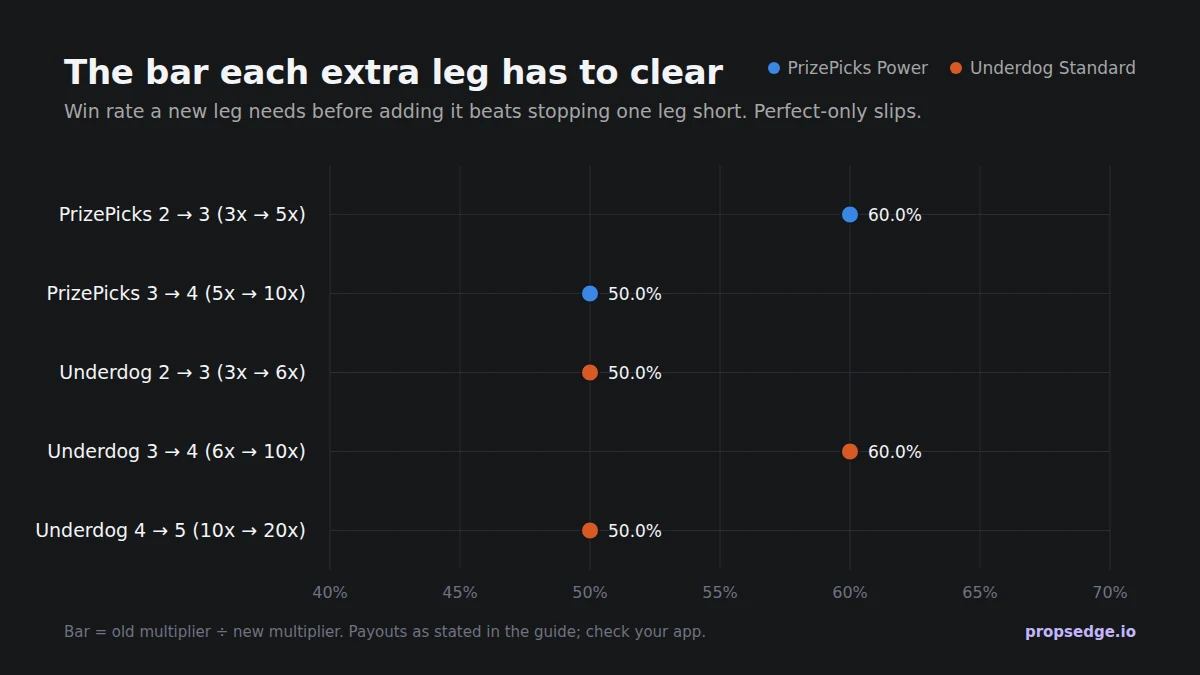
The ladder is not smooth, and the steps are different on each app. That is why the payout comparison matters: your third-best leg might belong on a PrizePicks Power 4 but not on an Underdog 4-pick, where the step from 3 to 4 legs needs 60%. For Flex slips, where near-misses pay, run the full numbers in the parlay calculator or the EV calculator rather than using the ratio.
Step 4: use correlation, avoid anti-correlation
The payout assumes your legs are independent. Two 58% legs that are unrelated both hit 33.6% of the time, and a Power 2 on them returns +0.9%. If the legs tend to hit together, say a quarterback's passing yards over with his top receiver's receiving yards over, the chance both hit rises. At 38% both-hit, the same Power 2 returns +14.0%, with no change to either leg on its own.
It cuts the other way too. Two legs that pull against each other (two running backs on the same team both over, a receiver's over with his own quarterback's under) might both hit only 30% of the time, and the Power 2 returns -10.0%. A good optimizer either builds correlation in deliberately or, if it cannot measure it, limits itself to one leg per game so that the independence the math assumes is roughly true. When you build by hand, do one or the other on purpose. The same game parlay guide covers why sportsbooks price correlation and pick'em apps mostly do not.
Step 5: size for the streaks
The longer the slip, the longer the dry spells. A Power 4 with four 58% legs is a strong slip at +13.2%, but it hits 11.3% of the time, about once every nine entries. The chance of 20 losing entries in a row is 9.1%, and it will happen to you. A Power 3 on 60% legs hits 21.6% of the time and still goes ten entries without a hit 8.8% of the time.
So: flat stakes, the same on every entry, one to three percent of what you have set aside for this. Never raise the stake to "win it back" after a drought; the drought is the math working as expected. The variance guide and the bankroll guide go deeper.
The routine
- Price: list every leg you like with its devigged probability at PrizePicks' number.
- Cut: drop anything below 55%. Mark anything above 58%.
- Choose the slip: mostly high-50s legs → Power 4 or Flex 5. Two or three legs above 60% → Power 2 or Power 3.
- Grow it one leg at a time: only add a leg that beats old multiplier ÷ new multiplier.
- Check the pairs: keep correlated legs, split anti-correlated ones across slips.
- Stake flat and log each entry with the probabilities you used, so you can check them against results.
What not to optimize for
- Hit streaks. A player who has gone over five straight times has usually been repriced. The Prop Streaks sheet shows the streak next to the current line for exactly this reason.
- The biggest multiplier. A Flex 6 at 25x is a great slip with six 58% legs (+40.2%) and a bad one with six coin flips.
- Filling a slip because the slate is short. A slip with one weak leg is worse than a smaller slip without it.
Doing it in PropsEdge: Slip Generator, Pick Builder and export
Everything above can be done by hand. In PropsEdge the same steps take a couple of minutes, and they run inside a PropsEdge membership.
1. Find legs with the DFS Optimizer. It lists PrizePicks, Underdog and DraftKings Pick6 legs with the true probability devigged from sharp sportsbooks next to the app's implied odds. Choose the exact slip you plan to play, such as a 4-pick Power or a 5-pick Flex, so the EV matches your entry. Then filter by EV range, probability threshold and the minimum number of books that must agree. That covers steps 1 and 2.
2. Or start from a finished slip with the Slip Generator. It builds ready-to-play pick'em slips from live odds and rebuilds them every minute. Each slip card shows the app, the slip type, the chance the whole slip hits, the payout and the EV. Open a card to see every leg with its fair probability, its edge over the app's price and how many books the probability came from. It follows the same rules as this guide:
- Every leg is a standard-payout line devigged from two or more sportsbooks.
- It never puts two legs from the same game on one slip, so the independence the EV math assumes roughly holds (step 4).
- Slips that fall below break-even are hidden. You can open them to see what the slate offers, but they are marked as losing slips, not recommendations.
If no slip is positive, it says so. That usually means the books have not posted full lines yet, and the edges tend to appear a few hours before game time.
3. Collect picks in the Pick Builder. Tap + next to any projection to add it, or use Add all to Pick Builder on a generated slip. The floating button at the bottom right opens My Picks, grouped by game, and your picks stay there as you move between leagues. Before you export, run step 3 on the list: drop any leg that does not clear old multiplier ÷ new multiplier.
4. Export the slip. Open the Export menu in My Picks and choose PrizePicks, FanDuel, DraftKings, Caesars, BetMGM, Hard Rock, Novig or Fanatics. The menu shows how many of your picks each one can take. The app or book opens in a new tab with those picks already in the slip. On a generated slip, Open whole slip does the same in one click where the app supports it, and each leg has its own Bet link. Always check the line in the app before you submit. Lines move, and a leg that was 58% at 64.5 yards is a different bet at 67.5.
5. Share it if you like. Share in My Picks turns the slip into a PropsEdge image for a group chat. Log the probabilities too, so you can check them against results later (step 6 of the routine).
The free cheat sheets and the Weekly Edge picks show the same method on the week's slate. The Underdog guide covers the other app's ladder.
An optimizer is only as good as the probabilities you feed it, and the discipline to stop adding legs. Bet what you can afford to lose. If it stops being fun, stop. Help is free and confidential at 1-800-GAMBLER.
Cover photo: All-Pro Reels, CC BY-SA 2.0, via Wikimedia Commons, color graded.



.jpg)