

DraftKings and FanDuel take more player prop money than every other US sportsbook combined. That has two consequences for you. Their main lines are the sharpest in the market, because that is where the volume is. And their menus are enormous, which means most of the value sits in the corners: alternate lines, less popular stats, secondary players, and prices that lag the rest of the market for a few hours. This guide, part of our How to Win series, is about finding those corners. The pick'em guides cover the fixed-payout apps; this is the sportsbook side.
Photo: xiquinhosilva, CC BY 2.0, via Wikimedia Commons, color graded.
What a prop costs you
A standard prop is posted at -110 or -115 on each side. Two -110 sides add up to 104.8% of probability, so the book holds 4.5% of the money on that market; at -115 both ways it holds about 6.5%. Your break-even at -110 is 52.4% and at -115 it is 53.5%. That is the bar every prop bet has to clear, and it is lower than any pick'em app's (54% to 59%), which is the first reason sportsbook props are the better product for a disciplined bettor.
Props are not always -110 both ways. When one side is -140 and the other +110, the book is telling you the fair line sits between the posted number and the next half-point. Read the shape of the price, not just the number. The odds guide covers converting any price to a probability; the devig calculator strips the juice from a two-sided market so you can see the book's own estimate.
The main line is usually right. The alternates are not always.
DraftKings and FanDuel offer a ladder of alternate lines on most props: a receiver's yards at 40.5, 50.5, 60.5, 75.5 and so on, each with its own price. The main line is sharp because it is bet heavily. The alternates are priced by a model, and models are smooth where real distributions are lumpy.
The pattern to look for: the price at an alternate implies a probability that does not match what the main line and the player's distribution say. If the main line is 62.5 at -110 (about 50% to clear 62.5) and the alt over 75.5 is +200 (33% implied), ask whether this receiver really has a one-in-three chance at 76 yards. For a low-volume, big-play receiver the answer is often yes and the +200 is fine; for a high-target, short-route receiver the true number is closer to 25% and the alt is a trap. The distribution matters more than the median. PropsEdge's player pages plot the game log against every line, so you can count how often he actually cleared 75 rather than guess.
Alternates work the same way in the other direction. "Under 40.5" at -250 is often better value than "under 62.5" at -110 when the risk you are fading is a blowup game, not a modest one.
Same game parlays
Both books push same game parlays hard, with boosted multipliers and prominent placement. Two facts about them:
Correlation is priced. When you stack a quarterback's passing yards over with his receiver's receiving yards over, the book's SGP engine reduces the payout below the product of the individual prices, because it knows they move together. On PrizePicks or Underdog, correlated legs are free equity; on DraftKings and FanDuel, most of that equity is taken back in the pricing. The SGP guide shows the math.
The hold compounds. A four-leg SGP with each leg at -110 has the book's margin applied four times. Even if the correlation adjustment were perfectly fair, the parlay would carry roughly four times the hold of a single. Boosts are usually sized to return part of that, not all of it.
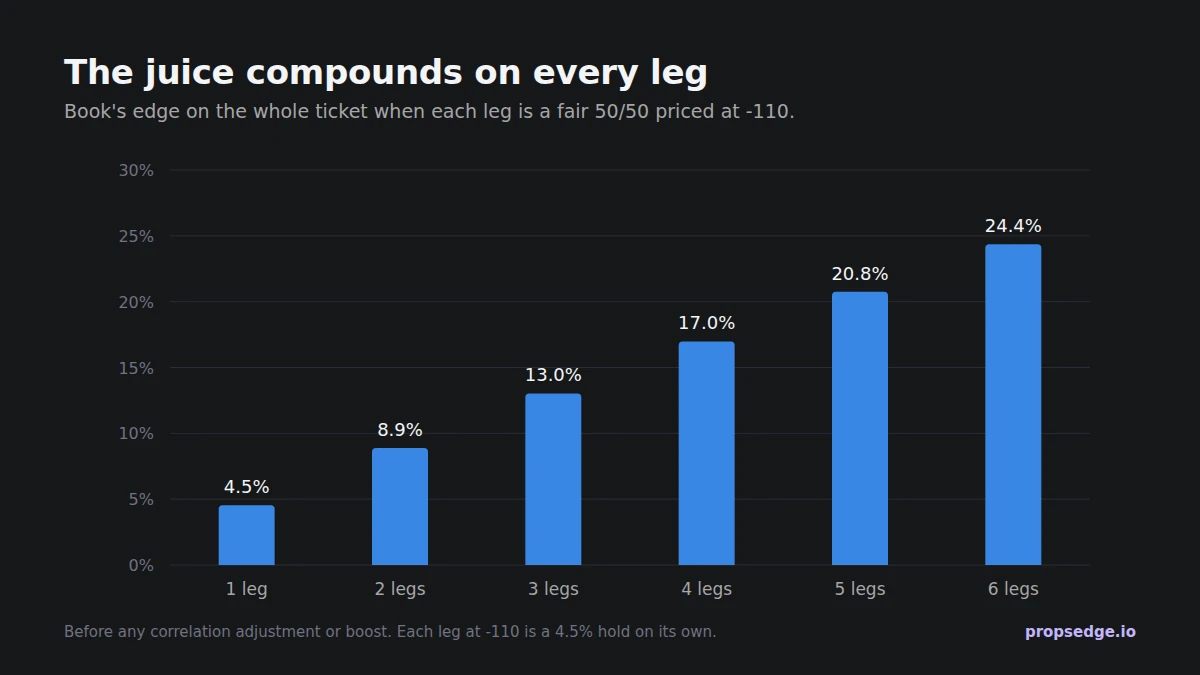
That does not make SGPs unplayable. It makes them a product to use when you have a genuine edge on each leg, not a way to turn a small edge into a big one. If two of your four legs are coin flips, the parlay is worse than betting the two good legs straight.
The edge that survives: shopping the same prop across books
DraftKings and FanDuel disagree with each other constantly, and both disagree with the other thirteen books we track. A receiver at 62.5 -110 on DraftKings might be 59.5 -110 on FanDuel and 64.5 on Caesars. If your number says 65, the bet is the FanDuel over at 59.5 and nothing else. Three yards of line is worth more than any handicapping insight you will have that week.
The routine:
- Decide the fair line before you look at prices. Use the projection, the game log distribution and the matchup. Write it down.
- Shop the market. Every PropsEdge player page lists that stat at 15+ books, sorted by price, with the same line highlighted where it exists. The Line Shopping cheat sheet does it for the whole NFL slate each week, free.
- Bet the best price, or the best line, whichever has more edge. Half a point of line is worth about 20 cents of price on a typical yardage prop; a full point is worth more than most price gaps you will find.
- Track closing line value. If the line you bet keeps moving your way by kickoff, you are beating the market and the results will follow. If it moves against you, the market disagrees, and no amount of green results changes that. The CLV guide explains why this is the only honest scorecard.
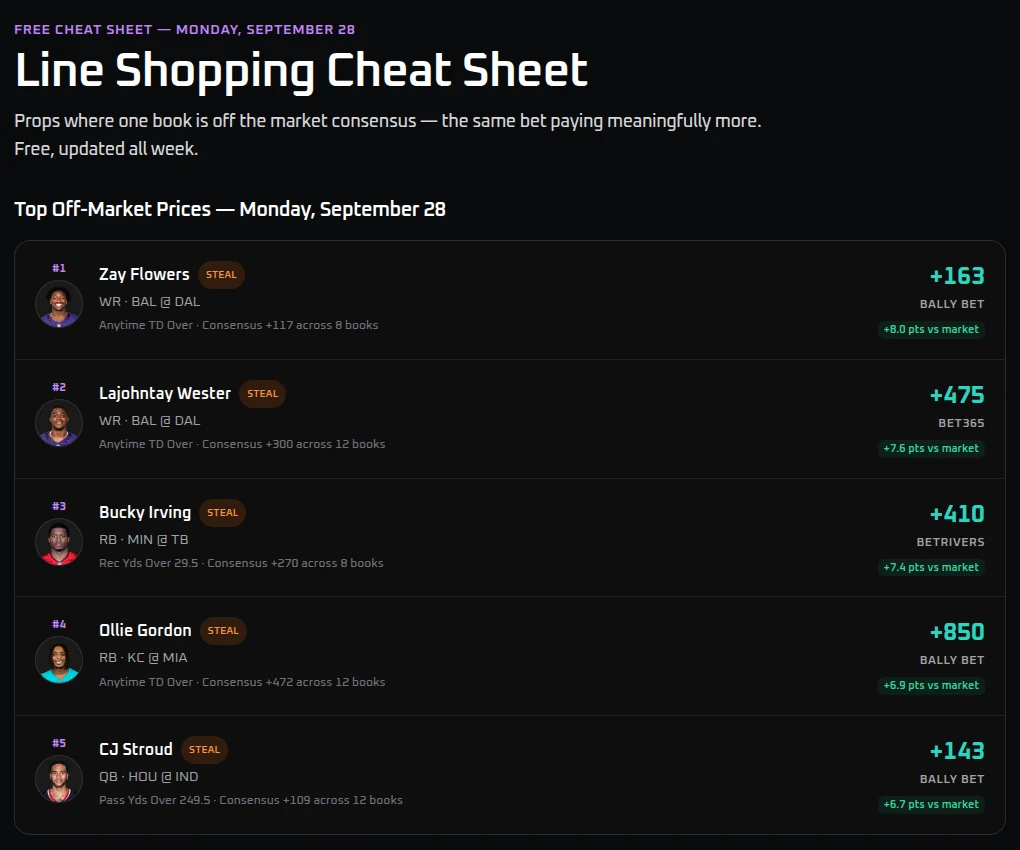
Screenshot of the free PropsEdge page, week of September 28, 2026. Prices move; open the page for today's.
Timing
Both books post most props the night before or the morning of the game, and the first few hours are the softest. Injury news moves lines within minutes on the main markets but slower on alternates and secondary players. A backup running back's rushing line the hour after the starter is ruled out is the best bet on the board, and it is gone by the time most people open the app. The cheat sheets refresh through the week so the usage cases are already built when the news hits.
Promos and boosts
DraftKings and FanDuel run profit boosts, no-sweat bets and odds boosts on a near-daily basis. The right way to think about all of them: a boost is worth taking on a bet you would make anyway, and it raises the value of that bet by exactly the boost. A "50% profit boost" on a -110 prop turns a 52.4% break-even into a 40% break-even, which is enormous, but only on a bet with real edge; it does not make a bad bet good, it makes it lose less. Never choose the bet to fit the boost. The promos guide covers valuing bonus bets and the promos page has current offers.
What not to do
- Bet the main line on a star because he is "due." It is the sharpest number on the board. The edge, if any, is on the third receiver's alt line.
- Build a six-leg SGP with two good legs. The four filler legs cost more than the two good ones earn.
- Chase a line that already moved. If the number is 59.5 everywhere and you liked it at 62.5, the market already agrees with you and has priced it. Find the next one.
- Bet different amounts because you feel differently. Flat stakes, one to three percent of bankroll, per the bankroll guide. Your feelings are not calibrated; your log is.
Where PropsEdge fits
PropsEdge puts DraftKings, FanDuel and 13+ other books on one screen per player, with the devigged Chance%, the game log against every line, and a Value sort across the slate. The sport guides walk through what to research in each league: NFL, NBA, WNBA, MLB. Bet what you can afford to lose. If it stops being fun, stop. Help is free and confidential at 1-800-GAMBLER.
Cover photo: Dialh, CC BY 4.0, via Wikimedia Commons, color graded.
.jpg)
