

A sportsbook sets a price on both sides of a game and keeps a margin whichever side wins. An exchange does neither. Novig and ProphetX match you against other bettors: someone wants the over, someone wants the under, and the exchange takes a small fee for introducing them. That one change moves where the money is made. On an exchange the price is set by the people trading, so it can be better than any sportsbook's, and you can set it yourself. This guide is part of our How to Win series. The Kalshi and Polymarket guide covers the prediction markets that price sports as contracts, and most of what follows applies there too.
Availability and the legal footing of both platforms changed quickly through 2026 and still differ by state. Check what is offered where you live before you fund an account.
How an exchange differs from a sportsbook
At a sportsbook, -110 on both sides of a coin flip means each side needs to win 52.38% of the time to break even. The two prices together imply 104.8%, and the extra 4.8% is the book's margin, a hold of about 4.5% of everything bet. You pay it on every bet whether you win or lose. The hold calculator works it out for any pair of prices.
On an exchange the two sides of a market are separate orders from separate people. The best price someone is offering on the over and the best price someone is offering on the under can sit almost on top of each other, because nobody needs to build a margin into both. The exchange earns its money from a fee instead, and the fee is much smaller than the juice.
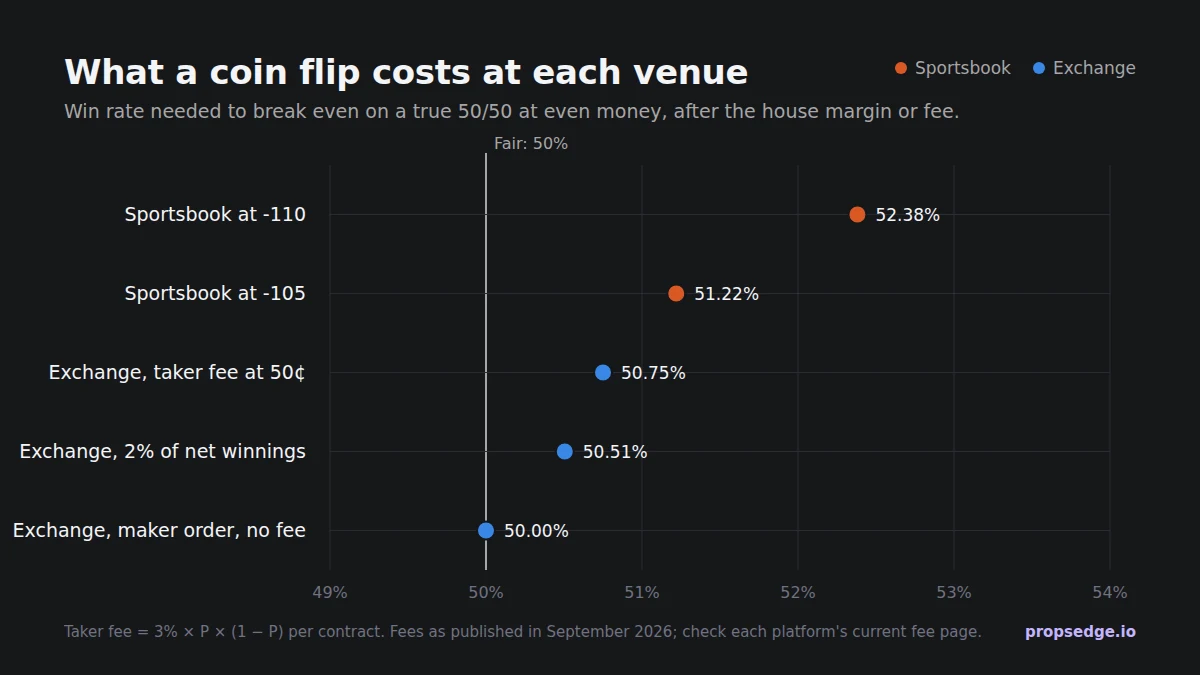
That gap is the whole case for exchanges. A bettor who wins 51.5% of their even-money bets loses money at -110 and makes money on an exchange.
What the fees cost
The two platforms charge in different ways. As published in September 2026 (check each platform's own fee page before you trade, because these change):
- ProphetX charges a commission of 2% on net winnings in a market, nothing on losing bets and nothing on parlays. A $100 bet at +150 wins $150, the commission is $3, and you keep $147, so +150 on ProphetX pays like +147 anywhere else. Break-even moves from 40.00% to 40.49%.
- Novig charges no fee at all on pre-game straight trades. On live straight trades the taker pays 3% × P × (1 − P) per $1 contract, where P is the price: 0.75 cents on a 50-cent contract, the most it can be, and less toward either end. Parlays are quoted with the fee already built into the price. Makers, the people whose resting orders get filled, pay nothing.
Both fees are small next to a sportsbook margin, and both shrink toward long and short prices, where a sportsbook's margin usually grows.
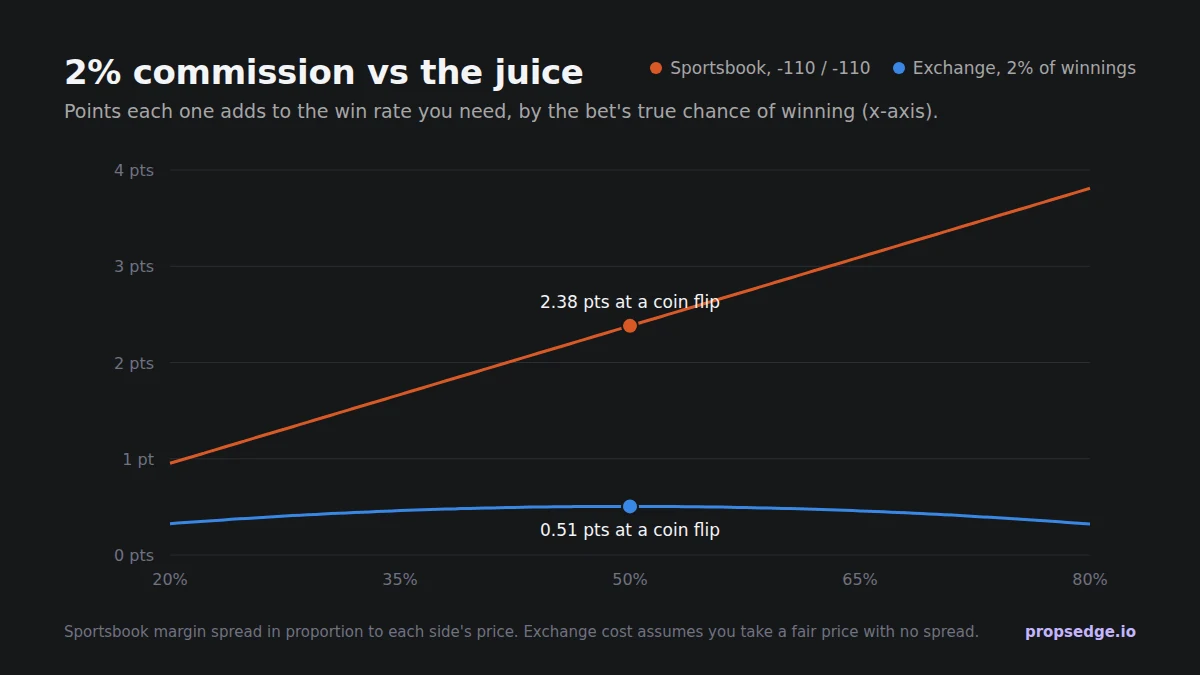
The catch is the spread. If the best offer on the over is -115 and the best offer on the under is -105, you pay the gap between them to get in right now, just as you would at a book. An exchange is only cheap when the market is busy enough that the two sides sit close together.
The edge: be the maker
On a sportsbook you can only take the price on the screen. On an exchange you can post your own and wait. That is the single biggest advantage the product gives you.
Say the sportsbooks' devigged price on a receiving yards over is 55%. The fair price for 55% is about -122. On the exchange, the over is being offered at -130 and nobody is taking the other side at anything better. You have three choices:
| Your price | Break-even | Expected value per $1 | After a 2% commission on wins |
|---|---|---|---|
| Take -130 now | 56.52% | -2.7¢ | -3.5¢ |
| Post -122 and wait | 54.95% | +0.1¢ | -0.8¢ |
| Post -115 and wait | 53.49% | +2.8¢ | +1.9¢ |
Taking the screen price loses. Posting at fair value is roughly break-even once a commission is taken out. Posting at -115 is a real edge, but only if someone fills it. Most of the time a resting order at a good price will not fill, and that is fine: you only bet when you get your number. The EV calculator runs this for any price and probability.
Two rules keep maker orders from hurting you:
- Cancel on news. A resting order is a free option for whoever reads the injury report first. If a starter is ruled out, your over at -115 is suddenly the best bet in the building for the other side. Pull orders before lineups and injury news, not after.
- Size to what you would bet anyway. A limit order is still a bet. Flat stakes, same as everywhere else (bankroll guide).
Use the exchanges as a sharper price
Even if you never trade on an exchange, a busy exchange market is useful information. The price there comes from bettors, not a trading desk protecting itself on both sides, so it often sits closer to the true probability than a single sportsbook's number. Two practical uses:
- Devig against it. When an exchange market is liquid, the midpoint between the best over and best under is a strong estimate of the fair price. Compare it with the devigged sportsbook consensus from the devig calculator. When the two agree and a book is well off both, that book's price is probably stale.
- Shop it. Exchanges are one more book in the line shop. Sometimes they are the best price on the board by a distance; sometimes nobody is offering the side you want at all. The line shopping guide explains why the best available price matters more than almost anything else, and the free Line Shopping sheet lists the week's biggest NFL price gaps.
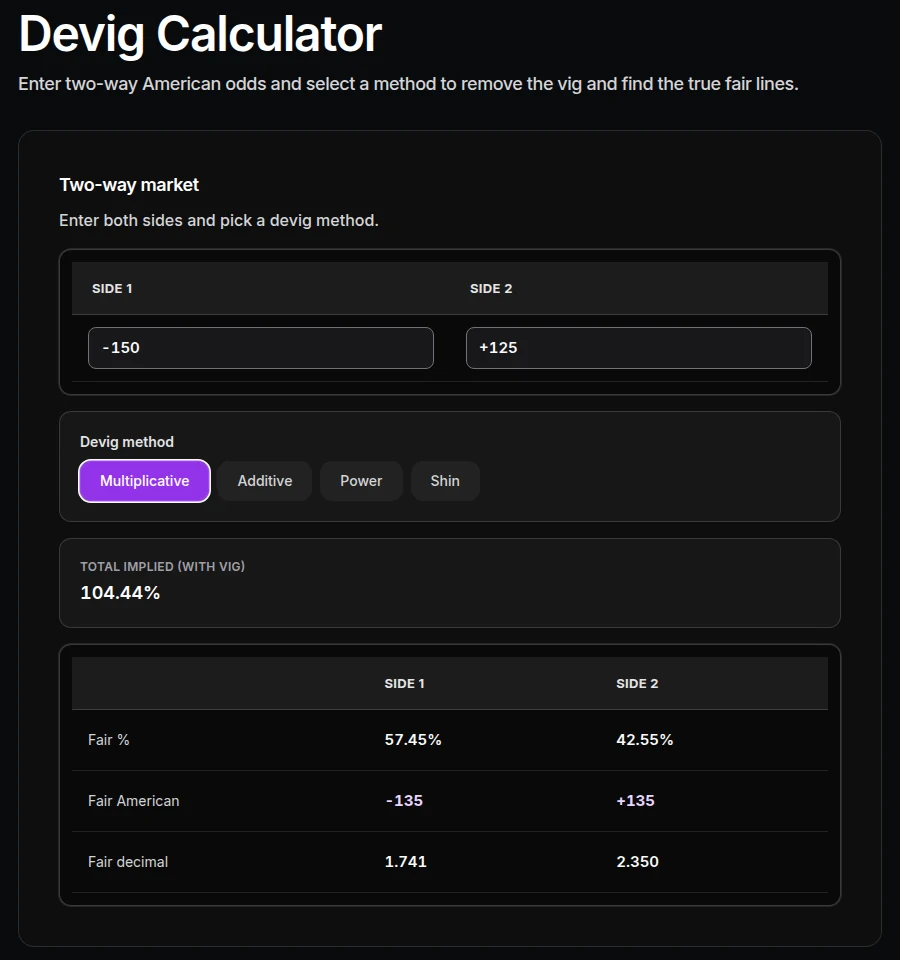
Devig the sportsbook market first. Here -150 / +125 is a fair 57.45%. An exchange offer better than about -135 on that side is worth a look.
The traps
Thin markets. Main lines on NFL and NBA games trade heavily; a backup tight end's receptions may have one resting order for $20. The price you see may not be there for the size you want, and a partly filled order leaves you with half a position. Check the available size before you rely on a price.
Settlement rules. Exchanges settle on their own written rules. Read what happens if a game is postponed, whether overtime counts and, above all, what happens if a player does not play. Sportsbooks usually void a prop for a player who is inactive; an exchange's rule may differ, and that is an expensive thing to learn after the fact. The Kalshi and Polymarket guide has the same warning for contract markets.
Parlays. ProphetX charges no commission on parlays, which makes them look cheap. A parlay of legs you have no edge on is still a losing bet; each leg has to clear its own bar first. The same game parlay guide explains why.
Arbitrage looks easier than it is. Exchange prices and sportsbook prices disagree often enough that arbitrage opportunities appear, but a thin exchange side can vanish before your second bet is placed. The arbitrage guide and arbitrage calculator cover how to size both sides.
A routine
- Build your number from the sportsbook market: devig the main books.
- Look at the exchange's best offer on each side and the size behind it.
- If the exchange price beats your number by enough to cover any fee, take it. If it does not, post a maker order at a price with real edge and walk away.
- Pull resting orders before injury news and lineups.
- Read the settlement rules for props, especially player participation.
- Log every fill with your fair price at the time. Your average edge over that number, across hundreds of bets, is your real result.
Where PropsEdge fits
PropsEdge shows Novig and ProphetX prices beside 15+ sportsbooks on its odds screens, with the juice already removed into a Chance%, so an exchange price and a sportsbook price sit on the same scale. The +EV and arbitrage screens have an Exchanges filter to include or exclude them, with a reminder to check the available size, and the Pick Builder can export a slip straight to Novig. It all comes with a PropsEdge membership. New to the platforms? Current sign-up offers for both are on our promos page, and how to value a bonus applies to them too. For the underlying math, start with how to read betting odds and how expected value works.
An exchange is the cheapest place to bet a price you are right about, and it lets you name that price. Bet what you can afford to lose. If it stops being fun, stop. Help is free and confidential at 1-800-GAMBLER.
Cover photo: Ank Kumar, CC BY-SA 4.0, via Wikimedia Commons, color graded.
_01.jpg)