
Prediction markets used to be about elections. Now the busiest contracts on Kalshi and Polymarket are NFL sides, NBA totals and, increasingly, player props. For a sports bettor they are a genuinely different product: there is no house setting a price and holding a margin on both sides. There is an order book, other traders, and a fee. That changes what "winning" means and where the edge comes from. This guide is part of our How to Win series; the DraftKings and FanDuel guide covers the sportsbook side of the same markets.
Availability differs by state and changes often, for both platforms and for the sports markets on them. Check what is offered where you are before you fund an account.
A contract is a probability with a price tag
Every contract settles at $1 if the event happens and $0 if it does not. A contract trading at 62 cents is the market saying "62% likely". Buying it at 62 and being right pays 38 cents of profit on 62 cents risked.
Converting to sportsbook odds so you can compare:
| Contract price | Implied probability | Equivalent American odds |
|---|---|---|
| 25¢ | 25% | +300 |
| 40¢ | 40% | +150 |
| 50¢ | 50% | +100 |
| 55¢ | 55% | -122 |
| 62¢ | 62% | -163 |
| 75¢ | 75% | -300 |
The formula: for a price c below 50 cents, American odds are +100 × (1 − c) / c. At or above 50 cents, they are −100 × c / (1 − c). The odds converter does it both ways.
The important difference from a sportsbook: there is no vig baked into the price. A sportsbook shows -110 on both sides of a coin flip, which is 52.4% each and 104.8% in total. A prediction market shows the Yes at 51 cents and the No at 50 cents, which is 101% in total, and the extra cent is the spread between buyers and sellers, not a house margin. On liquid markets that is a much cheaper place to bet.
What it actually costs: fees and spread
You pay in two places.
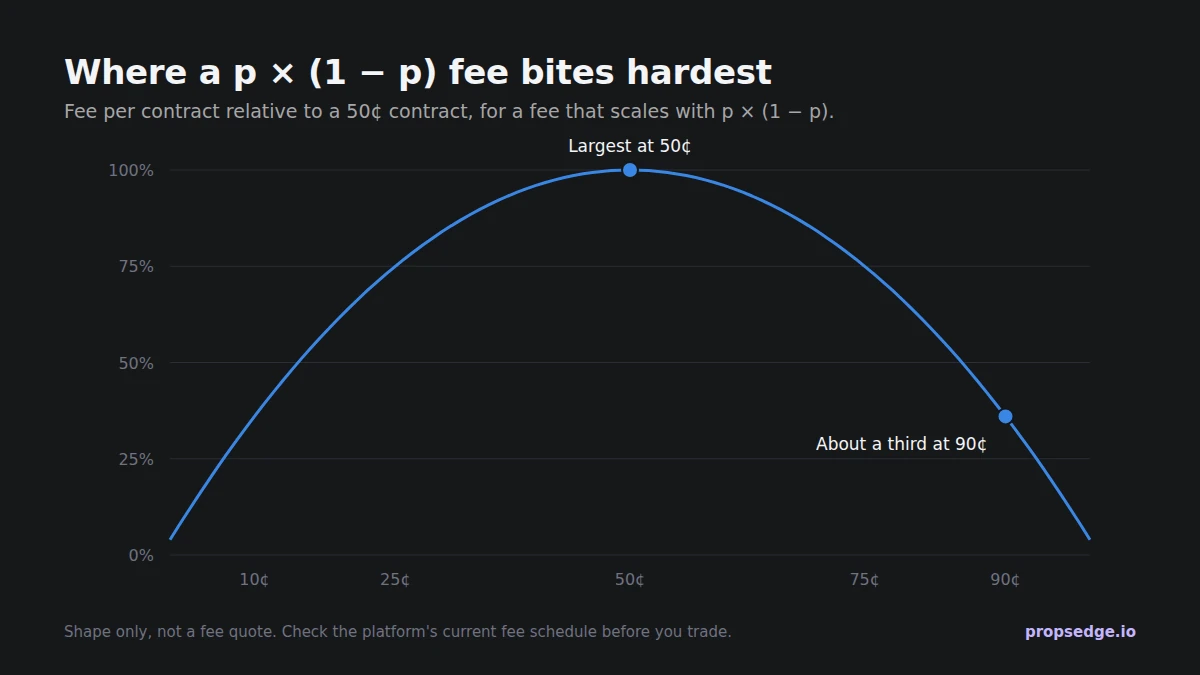
Fees. Both platforms charge trading fees, and they change. Kalshi's fee has been structured so that it scales with p × (1 − p), which makes it largest on contracts near 50 cents and smallest on contracts near 5 or 95 cents. Always read the current fee schedule and compute the fee on your actual trade; the fee on a 50-cent contract can be the difference between a small edge and none.
Spread. If the best bid is 60 and the best ask is 63, buying at the ask costs you 3 cents on a market whose midpoint is 61.5. That is 1.5 cents of cost before any fee, on every contract, every time you cross the spread. On a thin player-prop market the spread can be wider than any sportsbook's vig.
Your real break-even on a Yes bought at the ask is: (ask price + fee per contract). Compare that to your estimate of the true probability. If you think the event is 65% and your all-in cost is 64 cents, you have one cent of edge; that is very little.
Where the edge comes from
The same three sources as anywhere else, with one addition.
1. Price disagreement with the sportsbooks. The biggest sportsbooks' main lines, devigged, are the best public estimate of the true probability for most games. When a prediction market contract trades well away from that estimate, one of them is wrong, and it is usually the thinner market. Devig the DraftKings or FanDuel price with the devig calculator, compare it to the contract's all-in cost, and only trade the gaps that clear fees and spread.
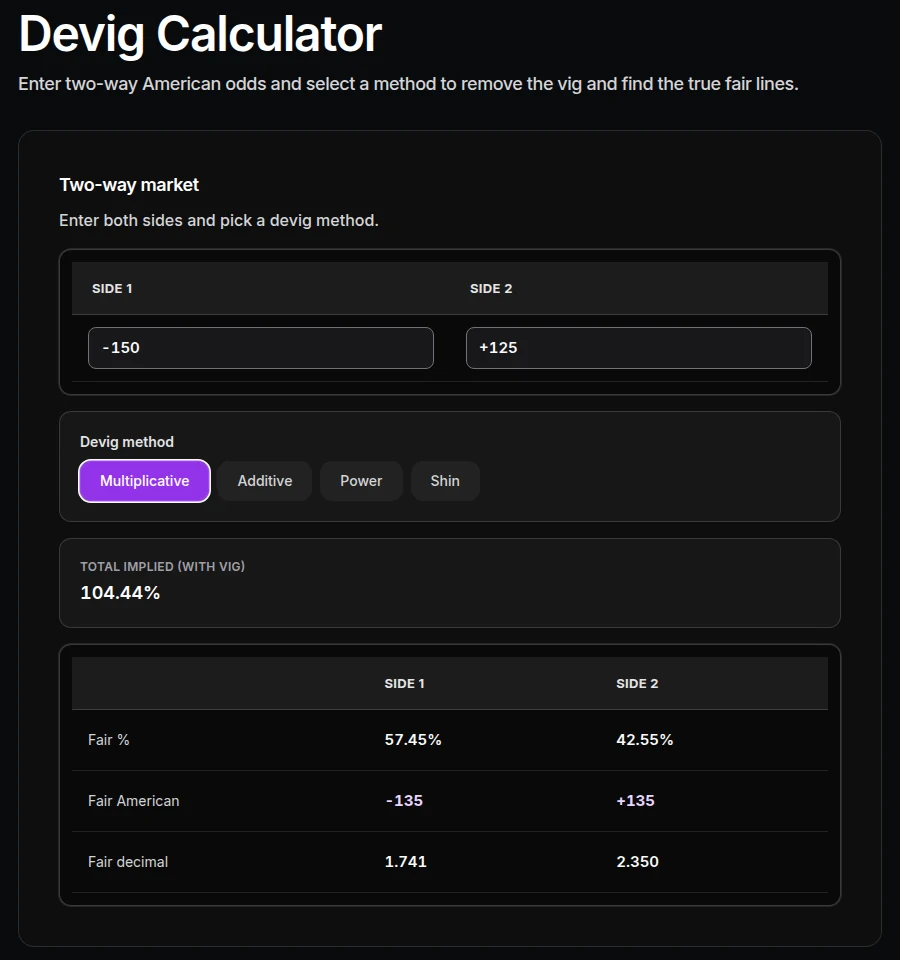
Devig the sportsbook market first. Here -150 / +125 is a fair 57.45%, so a Yes contract is only worth buying below about 57 cents, fees included.
2. Line shopping across both kinds of venue. Prediction markets are one more book to shop. On the Week 3 Line Shopping pick in our Weekly Edge, Kalshi's price on the same anytime TD was +331 while three sportsbooks sat at +475: the prediction market was the worst place to bet that one. Sometimes it is the best. PropsEdge includes Kalshi prices alongside 15+ sportsbooks where it lists the same market, so you see both in one place; the line shopping guide explains why the best available price is the single largest lever you have.
3. Being early on news. Sportsbooks move their main lines within minutes of injury news. Prediction market order books move when traders move them, and on smaller markets that can take longer. A resting order you placed before the news is filled at the old price; a fresh order after the news is not.
4. Being the one who sets the price. This is the one that is unique to exchanges. You do not have to take the price on the screen. You can post a limit order at the price you want and wait for someone to trade with you. A limit order that is filled means you paid the bid instead of the ask, you captured the spread instead of paying it, and on some platforms your fee as the maker is lower or zero. Patient traders who only post limits at prices with edge and let the market come to them are playing a different game from the people clicking "buy" at the ask.
Resolution rules: read them every time
A sportsbook bet on "Player X over 64.5 receiving yards" settles on the official stat. A prediction market contract settles on its written rules, and those rules can differ in ways that matter:
- What happens if the game is postponed, suspended or played on a different date.
- Whether overtime counts, which is not always the default you assume.
- Which source is official, and when the market resolves relative to stat corrections.
- What happens if the player does not play at all. Sportsbooks void; a prediction market might resolve No.
That last one is the most expensive surprise in sports prediction markets. On a sportsbook, "Player X anytime TD" is refunded if he is scratched. On a market that resolves "Did Player X score a touchdown?" a scratch is a No. Read the rules before you buy a Yes on a player who is questionable.
Sizing and staying solvent
Exchanges make it easy to trade in and out, and that tempts people into turning a position into a day trade. If your edge was the pre-game price gap, holding to settlement collects it; selling early usually pays the spread twice. Flat stakes, one to three percent of bankroll per position, same as anywhere else. The bankroll guide has the full version, and the variance guide explains why a real edge still loses for long stretches.
Prediction market profits are taxed like any other gambling or trading income. The platforms issue their own tax documents; keep your own log of every trade anyway.
A routine
- Build your probability from the sportsbook market first: devig the main line at the two biggest books.
- Compare it to the contract's all-in cost at the ask, fees included. No gap, no trade.
- If there is a gap but it is thin, post a limit order at a price that gives you real edge and let it fill or not.
- Read the resolution rules, especially voids, overtime and non-participation.
- Hold to settlement unless the reason you entered is gone.
- Log the trade with the sportsbook's devigged price at entry. Your edge over that number, averaged over hundreds of trades, is your real skill.
Where PropsEdge fits
PropsEdge lists Kalshi alongside DraftKings, FanDuel and 13+ other books where the market matches, with the juice already removed into a Chance% so you can compare a sportsbook price and a contract price on the same scale. The cheat sheets find the props worth pricing each week. If exchange pricing is new to you, how to read betting odds and how expected value works are the foundations.
A prediction market is the cheapest place to bet a price you are right about and an expensive place to bet one you are guessing at. Bet what you can afford to lose. If it stops being fun, stop. Help is free and confidential at 1-800-GAMBLER.
Cover photo: Chad Davis, CC BY 2.0, via Wikimedia Commons, color graded.