

PrizePicks is the simplest betting product in America. Pick two to six players, say "more" or "less" on the number next to each name, and the app pays a fixed multiple if enough of them hit. There is no line to read, no juice to calculate, no book to shop. That simplicity is exactly why most people lose on it: the math is hidden inside the payout table, and the table is not on your side unless your picks are.
This guide is the math, then the edge. Every number below is computed, not quoted, so you can redo it if your app shows a different payout. This is the first post in our How to Win series; the Underdog guide covers the other big pick'em app and the payout comparison puts them side by side.
How PrizePicks pays
Two entry types. A Power Play pays only if every pick hits. A Flex Play pays a smaller multiple on a perfect slip but still pays something if you miss one (or, on five- and six-pick slips, two). Payouts at the time of writing, for standard picks with no promotions attached:
| Slip | Perfect | One miss | Two misses |
|---|---|---|---|
| Power, 2 picks | 3x | 0 | 0 |
| Power, 3 picks | 5x | 0 | 0 |
| Power, 4 picks | 10x | 0 | 0 |
| Flex, 3 picks | 2.25x | 1.25x | 0 |
| Flex, 4 picks | 5x | 1.5x | 0 |
| Flex, 5 picks | 10x | 2x | 0.4x |
| Flex, 6 picks | 25x | 2x | 0.4x |
Payouts change, differ by state, and drop on picks the app flags as easier ("goblins") or rise on picks it flags as harder ("demons"). Always read the multiplier the app shows before you submit. If it differs from this table, recompute with the parlay calculator or the formula at the end.
The number that decides everything: break-even win rate
Every pick on PrizePicks is a coin flip the app wants you to believe is fair. Turn each payout into the per-pick hit rate you need just to get your money back over time:
| Slip | Break-even hit rate per pick | Your return if you hit 55% | Your return if you hit 60% |
|---|---|---|---|
| Power 2 (3x) | 57.7% | -9% | +8% |
| Power 3 (5x) | 58.5% | -17% | +8% |
| Power 4 (10x) | 56.2% | -9% | +30% |
| Flex 3 (2.25x / 1.25x) | 59.1% | -12% | +3% |
| Flex 4 (5x / 1.5x) | 56.9% | -9% | +17% |
| Flex 5 (10x / 2x / 0.4x) | 54.3% | +5% | +43% |
| Flex 6 (25x / 2x / 0.4x) | 54.2% | +8% | +66% |
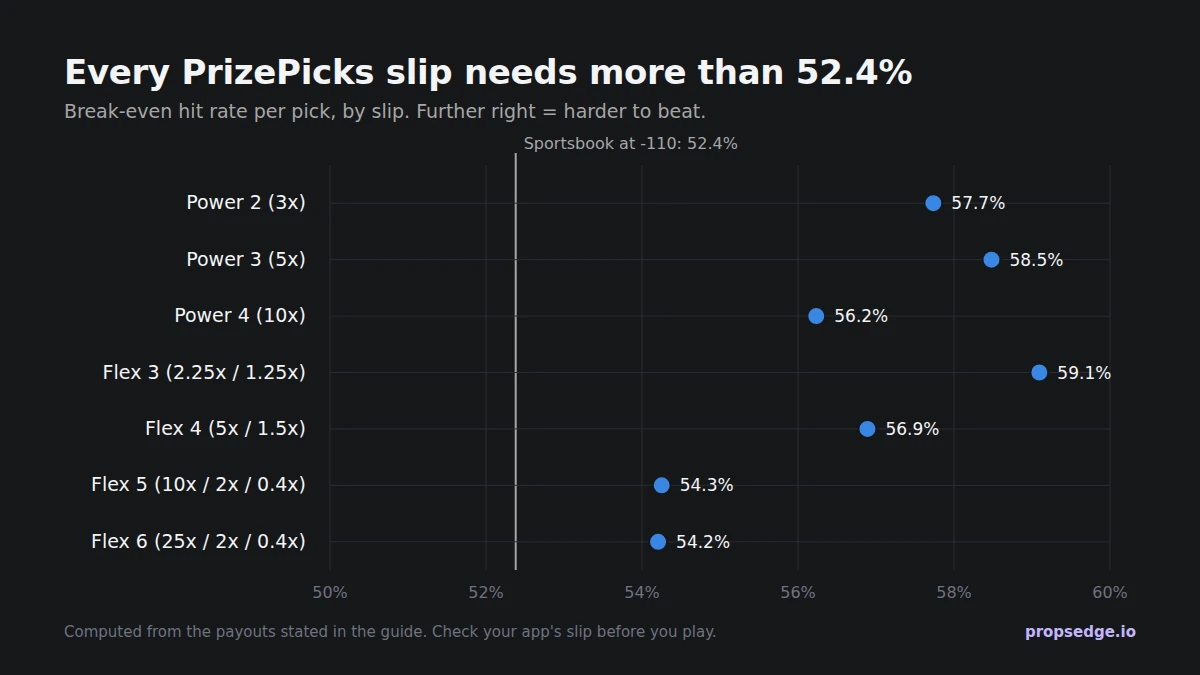
Three things fall out of that table.
A sportsbook only needs 52.4% from you. A standard -110 line breaks even at 52.4%. PrizePicks needs 54% to 59% depending on the slip. The app's convenience costs you two to seven points of win rate per pick, which is the whole reason "just pick your favorite players" loses.
The five- and six-pick Flex are the cheapest slips to play. They break even around 54%, the closest thing to sportsbook pricing on the app. They are also the highest variance: a six-pick perfect slip at 54% per pick lands about 2.5% of the time. You are paid mostly by the one-miss and two-miss consolations, and you will see long stretches of small losses between the big hits. The variance guide explains why that is survivable and the bankroll guide explains how to size for it.
The three-pick Flex is the worst deal on the board. A 59% per-pick requirement is brutal. If you like three plays, a Power 3 at 58.5% is barely better; put the third leg on a bigger Flex slip instead, or leave it.
Where the edge actually comes from
You cannot beat the payout table by knowing football better than the crowd. You beat it by finding picks where the true probability is well above the break-even, and there is exactly one reliable way to see that: compare the PrizePicks line to the sportsbook line on the same stat.
Sportsbooks price player props against sharp money all day. PrizePicks posts one number, often earlier, and moves it less often. When the two disagree, the sportsbook is usually right, and the disagreement is your edge:
- PrizePicks has a receiver at more/less 54.5 receiving yards. Six sportsbooks have him at 62.5, with the over at -115. The books are telling you the true median is around 62. "More 54.5" is not a coin flip; at that line the over is closer to 60% or better.
- PrizePicks has a running back at more/less 0.5 touchdowns (an anytime TD pick). The books have his anytime TD at -150. Remove the vig and that is about 57% to score. "More" clears every break-even in the table above; "less" does not.
The size of the gap matters more than anything else you will read about the player. A half-point difference on a rebounds line is noise. Five yards on a receiving line, a full point on a points line, or an anytime-TD price that devigs to 58% or better is a pick.
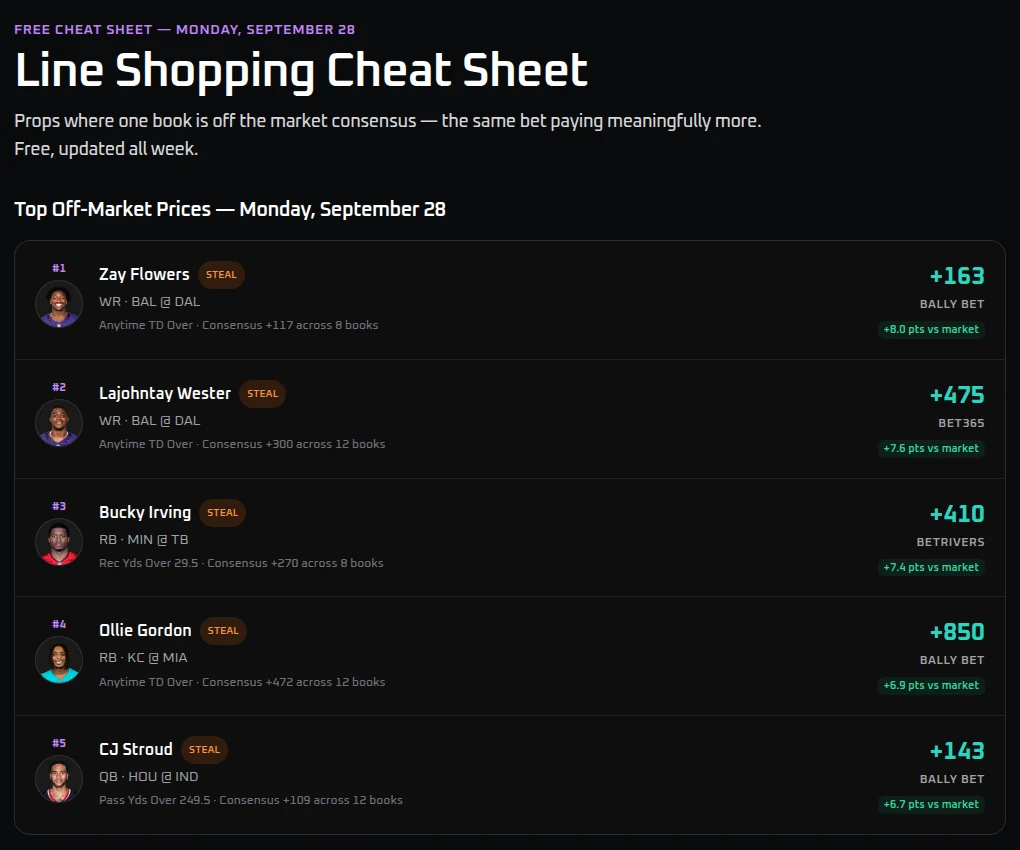
Screenshot of the free PropsEdge page, week of September 28, 2026. Prices move; open the page for today's.
To turn a sportsbook price into a probability, strip the juice with the devig calculator, or read the Chance% column on any PropsEdge projections page, which already does it against every book we track. Then compare it to the break-even for the slip you are building. If it does not clear the bar by a margin, it does not go on the slip.
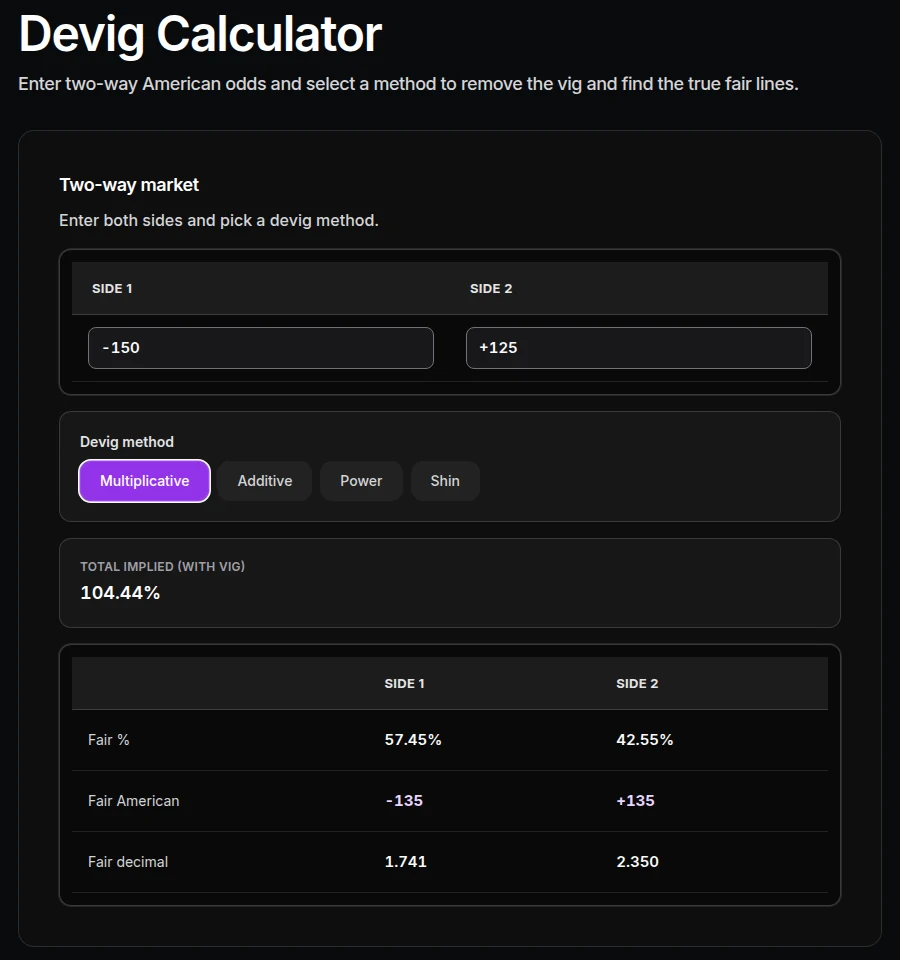
The -150 anytime TD from the example above, devigged: about 57% to score.
Correlation: the one thing the payout table does not price
PrizePicks pays a fixed multiple whether your picks are independent or move together. It prices every leg as if it were a coin flip on its own. Legs that win and lose together turn that into an edge, because a parlay pays on the whole slip hitting and correlated legs hit together more often than independent ones do.
The classic pairs:
- A quarterback's passing yards more with his top receiver's receiving yards more. If the game becomes a shootout, both clear.
- A running back's rushing attempts more with the same team's opponent's passing attempts more (the team ahead runs; the team behind throws).
- Two players on the same high-total, close-spread game going more. Pace lifts every counting stat in the game.
- A starter's points more with a teammate's assists more in the NBA.
The app restricts some same-game combinations and the rules change. Build the slip, and if it refuses a pair, swap the leg rather than the idea. Never stack legs that are negatively correlated (two running backs on the same team going more, a receiver's yards more with his quarterback's interceptions more) unless the price gap on each is large enough to carry it alone.
A routine that holds up
- Start from the lines, not the players. Open the slate and find the picks where the PrizePicks number sits furthest from the sportsbook consensus. The Line Shopping cheat sheet does this for NFL props across the books we track, and each sport's projections page shows the book lines next to the app line on every player.
- Devig the book price at the app's line and keep only picks above 58% for Power slips, above 55% for five- and six-pick Flex. Those are conservative bars; the closer you play to break-even, the more your results are luck.
- Look for a correlated partner among the picks that already qualified. Do not add a weak leg to chase correlation.
- Check the injury and usage news last, not first. A line that has not moved after a starter was ruled out is the best pick on the board; a line that already moved is the market catching up, not an edge. If a player is scratched after you submit, the app voids that leg and re-rates the slip, so late news can shrink your payout but rarely kills it.
- Stake flat. One to three percent of your bankroll per slip, the same every time, regardless of how sure you feel. Six-pick Flex slips at 2% each will feel slow. That is the design working.
- Log every slip with the line, the book consensus at the time, and the result. After 200 slips you will know your real hit rate per pick, and the table above tells you exactly what that hit rate is worth on each slip type.
Things that feel like edges and are not
- Hot streaks. A player who has gone over five straight is priced for it. The Prop Streaks cheat sheet is useful precisely because it shows the streak and the line, so you can see when the line has not caught up.
- "Goblin" picks. The app marks easy picks and cuts the multiplier. Easy is priced in. Compare the reduced payout's break-even before assuming a 70% pick at 0.5x the multiple is good.
- Promo multipliers on random legs. A boosted payout is worth taking only if the pick clears the bar on its own; a bad pick at 1.5x is still a bad pick.
- More legs for more money. Every leg you add multiplies your break-even requirement's cost. Six legs at 54% each lose; six legs at 58% each print. The count is not the strategy; the per-leg quality is.
The formula, so you never have to trust a table
For a slip of n picks each hitting with probability p, the return per dollar is the sum over each outcome of (probability of that outcome) times (its payout). For a Power slip that is simply pⁿ times the multiplier. For a Flex slip, add the one-miss term: n × pⁿ⁻¹ × (1 − p) × (one-miss payout), and the two-miss term where it exists. Break-even is the p that makes the total equal 1. The EV calculator and parlay calculator do this for any payout the app shows you.
Where PropsEdge fits
Every projections page in PropsEdge shows the same player's line at PrizePicks next to 15+ sportsbooks, with the devigged Chance% and a Value toggle that ranks the slate by the gap. The cheat sheets surface the biggest gaps and the strongest usage cases each week, and the free previews need no account. If you are new to reading the underlying prices, start with how to read betting odds and how expected value works.
PrizePicks is a good product for one kind of bettor: the one who treats every pick as a price and only plays the ones the market says are wrong. Everything else is entertainment, which is fine, as long as you size it like entertainment. Bet what you can afford to lose. If it stops being fun, stop. Help is free and confidential at 1-800-GAMBLER.
Cover photo: Dennis Cortés cortes, CC0, via Wikimedia Commons, color graded.

.jpg)