

Underdog Fantasy started as a best-ball site and became the second biggest pick'em app in the country. Its pick'em product works like PrizePicks: choose players, take Higher or Lower on the number, and get a fixed multiple if enough legs hit. The payout ladder is different, the lines are set by a different trading team, and both of those differences are where you make money. This is the Underdog entry in our How to Win series; read the PrizePicks guide for the same treatment of the other app, and the payout comparison for the two side by side.
The two slip types
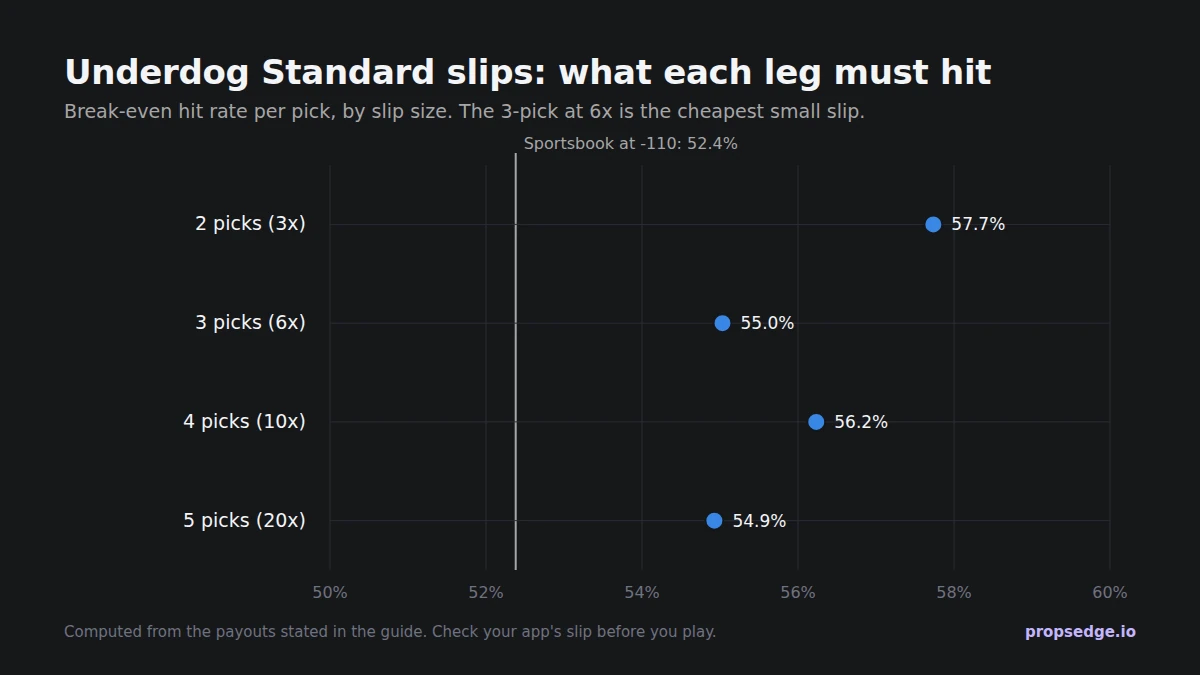
Standard entries pay only on a perfect slip. Flex entries pay a smaller top multiple but still return something with one miss, and on bigger slips two. Standard payouts at the time of writing:
| Standard slip | Payout | Break-even hit rate per leg | Return at 55% per leg | Return at 60% per leg |
|---|---|---|---|---|
| 2 picks | 3x | 57.7% | -9% | +8% |
| 3 picks | 6x | 55.0% | 0% | +30% |
| 4 picks | 10x | 56.2% | -9% | +30% |
| 5 picks | 20x | 54.9% | +1% | +56% |
The Flex ladder moves more often than the Standard one and depends on how many legs you take and whether any carry a modified multiplier, so read it off the slip screen and plug it into the parlay calculator before you submit. The method is the same: turn the payouts into the per-leg hit rate you need, then only play legs that clear it comfortably.
Two things stand out in the Standard table.
The three-pick Standard at 6x is the best small slip on either major app. It breaks even at 55.0% per leg, versus 58.5% for the equivalent PrizePicks Power 3. If you have three strong plays, this is where they go.
The five-pick Standard at 20x is a genuine long shot with a fair price. A 54.9% break-even is close to sportsbook territory, but a perfect five at 55% lands about 5% of the time. You will lose 19 of every 20 slips on average, and the twentieth pays for them. That only works with flat, small stakes and a bankroll that can absorb a 40-slip drought without changing anything. The variance guide walks through why those droughts are normal.
For comparison, a standard -110 sportsbook line breaks even at 52.4%. Every Underdog slip asks for more than that. The gap is the app's margin, and you close it with line selection, not with sports knowledge.
Underdog's lines are the product
Underdog sets its own numbers. They are often posted earlier than the sportsbooks', they move less often, and the trading team has more markets to watch than any book does. That produces the single most valuable thing on the app: a Higher/Lower line that sits away from the sportsbook consensus on the same stat.
When Underdog has a player at 22.5 points and the books have him at 25.5 with the over at -110, the market is telling you the true median is about 25. "Higher 22.5" is closer to a 60% proposition than a 50% one, and 60% clears every break-even in the table above with room to spare. The reverse case is a "Lower" pick.
The routine is simple and it never changes:
- Find the gaps. Every PropsEdge projections page shows Underdog's line beside 15+ sportsbooks for the same player and stat. The Value toggle sorts the whole slate by the size of the gap; the Line Shopping cheat sheet does the same for NFL props each week without an account.
- Convert the book price to a probability at Underdog's number, not the book's. Use the devig calculator, or read the Chance% column, which already removes the juice.
- Keep only legs above the bar. For Standard slips, 58% or better. For five-pick slips or Flex, 56% or better. Playing right at break-even means your results are entirely variance.
- Then, and only then, check the news. A line that has not moved after a lineup change is the best pick you will find all week. A line that has already moved is the market catching up, and the gap you saw is gone.
The size of the gap is the only thing that matters. Half a rebound is noise. Three points, five receiving yards, a full assist, or an anytime-TD price that devigs to 58% or better is a play. If a player's Underdog line matches the books to the half-point, there is no edge there regardless of how good the matchup looks; skip him.
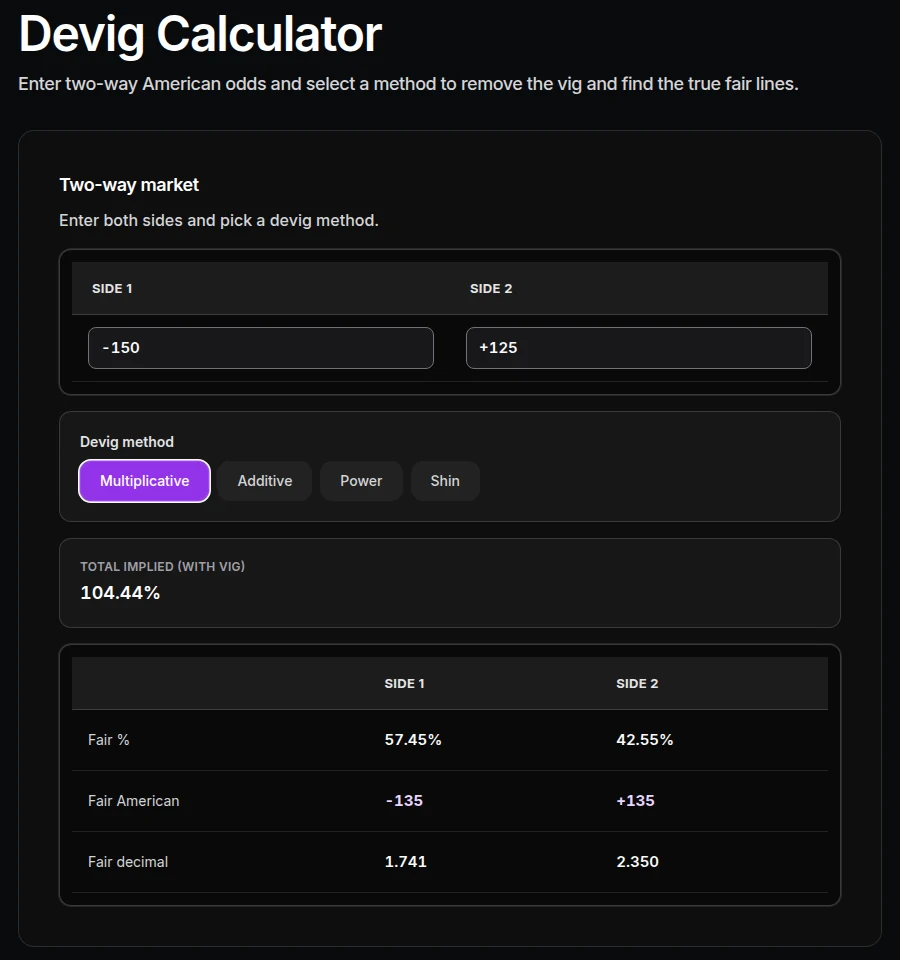
Devig the book's price at Underdog's number: -150 / +125 is a 57.45% proposition, which clears every Standard slip's break-even.
Correlation
Underdog pays the same multiple whether your legs are independent or tied together. A parlay pays on the whole slip landing, and legs that land together land more often than the payout assumes. That is free equity if you take it:
- A quarterback's passing yards Higher with his primary receiver's receiving yards Higher.
- A running back's rushing attempts Higher with the opposing quarterback's passing attempts Higher. One team is ahead and running; the other is behind and throwing.
- Two skill players from the same high-total, tight-spread game both Higher. Pace raises every stat in the game.
- In the NBA, a guard's assists Higher with his center's points Higher.
Underdog blocks some same-game combinations and the list changes; if it refuses a pair, swap the leg rather than force it. Avoid legs that pull against each other (two backs on one team both Higher, a receiver Higher with his own quarterback's interceptions Higher) unless each clears the bar alone.
Insurance, boosts and the other decorations
Underdog layers promotions over the base ladder: entry insurance that refunds a one-miss slip, multiplier boosts on selected legs, and periodic payout bumps. Treat every one of them the same way: compute the break-even of the slip as actually offered, then decide. Insurance lowers the hit rate you need, sometimes a lot, so an insured five-pick can be worth playing with legs that would not qualify uninsured. A boosted multiplier on a leg that does not clear the bar on its own is still a losing leg; the boost makes it lose less, not win. The promos guide covers how to value a bonus in general, and the promos page has the current offers.
One rule that never bends: if a player is scratched after you submit, the leg is voided and the slip is re-rated at the smaller size. Late news shrinks payouts; it rarely kills them. Do not chase last-minute legs to "protect" a slip.
Sizing
Flat stakes, one to three percent of the bankroll you have set aside for this, identical on every slip. The temptation on Underdog is to press the 20x five-pick when you feel good about the slate. The 20x pays for a season of small losses only if the stake is the same on the losing slips as on the one that hits. The bankroll guide has the full version.
What is not an edge
- Recent form on its own. A player on a six-game Higher streak has been repriced. The Prop Streaks cheat sheet is built to show the streak next to the line so you can tell when the number has lagged.
- Big names. Star players carry the sharpest lines on the app because everyone bets them. The gaps live on the third receiver and the backup center.
- More legs for a bigger number. Each added leg raises what the slip demands from every other leg. Five legs at 58% each print; five legs at 54% each lose slowly forever.
- Following someone's "locks." Ask what line they got and what the books had at that moment. If they cannot tell you, they were guessing.
The formula
For n legs each hitting with probability p, a Standard slip returns pⁿ times the multiplier per dollar. A Flex slip adds n × pⁿ⁻¹ × (1 − p) × (one-miss payout), and the two-miss term where it exists. Break-even is the p at which the total equals 1. The EV calculator and parlay calculator accept any payout Underdog shows you.
Where PropsEdge fits
PropsEdge tracks Underdog alongside 15+ sportsbooks on every player page, so the gap between the app's line and the market is visible at a glance, with the devigged Chance% and a Value sort across the slate. The cheat sheets do the weekly screening for NFL, MLB, NBA and WNBA, and each has a free preview. For the underlying math, start with how to read betting odds and how expected value works.
Underdog rewards one habit above every other: refusing to play a leg the sportsbooks price as a coin flip. Bet what you can afford to lose. If it stops being fun, stop. Help is free and confidential at 1-800-GAMBLER.
Cover photo: Michael Barera, CC BY-SA 4.0, via Wikimedia Commons, color graded.
.jpg)