
Receiving yards are the most bet player prop in football after touchdowns, and the one where a season average misleads the most. A receiver who "averages 55 yards" does not go over 54.5 half the time. One 60-yard catch in October props up his average for the rest of the year, while his typical game sits lower. This guide shows how to build a receiving yards number from the pieces that drive it, why the median matters more than the average, and how routes, speed and price fit in. It is part of our Sport Guides series; the NFL player props guide covers rushing, receptions and touchdowns.
How the bet works
A receiving yards prop is an over/under on the yards a player gains on catches, including yards after the catch. A line of 54.5 means the over needs 55 or more. Rushing yards do not count, and a catch for a loss takes yards away. Lines usually come with prices near -110 on each side, and most books also offer alternate lines: a lower number at a shorter price or a higher number at a longer one. The odds guide explains how to turn any of those prices into the chance they imply.
Build the number from targets
Receiving yards are three things multiplied together:
- Targets. How many times the ball comes his way. This is the biggest driver and the most stable from week to week: his share of the team's targets times the passes the team is likely to throw.
- Catch rate. The share of those targets he catches. Short, easy targets are caught more often; deep shots less often.
- Yards per catch. How far each catch goes. Deep threats run long per catch with more misses; slot receivers and backs catch more but gain less on each.
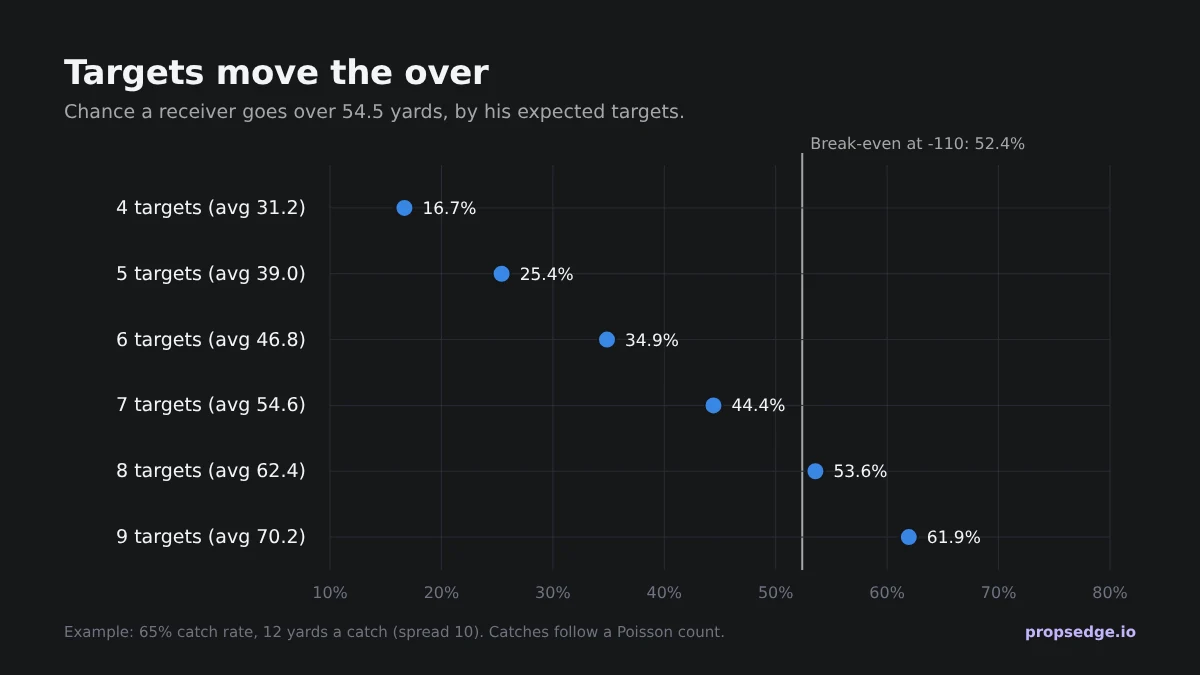
In the example above, with a 65% catch rate and 12 yards a catch, each extra target is worth about 7.8 yards on average. Against a 54.5 line, going from 7 expected targets to 8 moves the over from 44.4% to 53.6%, from a losing bet to one just above what -110 needs. That is why target share is the first thing to check, and why news that changes it (a teammate ruled out, a new quarterback, a team that will be chasing points) moves receiving lines more than anything else.
Why the median matters
Receiving yards are skewed. Most games land in a middle range, but one long catch can add 40 or 50 yards on its own, and nothing pulls the other way: a receiver cannot lose 50 yards. So a handful of big games drag the average above the typical game.
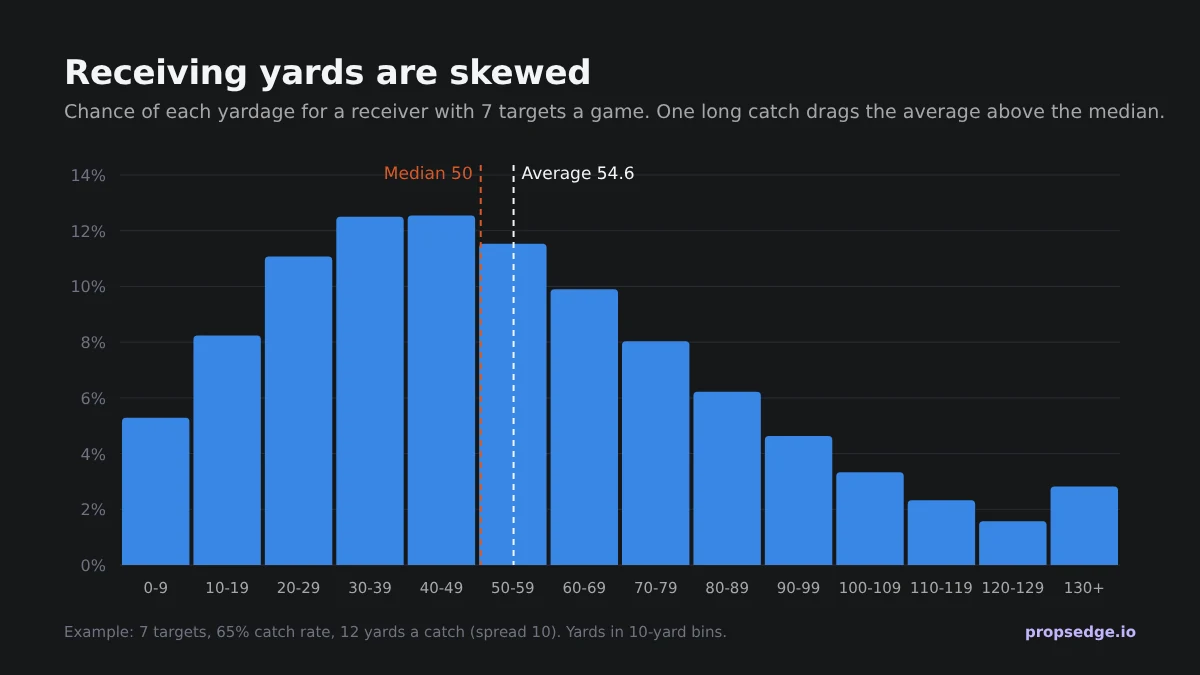
For the same 7-target receiver, the average is 54.6 yards but the median is 50. A line set at his average, 54.5, goes over only 44.4% of the time; the line where the over is close to a coin flip is 49.5, at 50.4%. He also has a 10.0% chance of 100 or more and a 5.3% chance of fewer than 10. Three things follow:
- Compare the line to his median, not his average. A season average inflated by one long touchdown makes the over look better than it is.
- Unders are not boring. When the line sits at a skewed average, the under is the side that wins more often.
- Small line moves matter. In the example, 44.5 goes over 56.6% of the time and 59.5 only 38.8%. Five yards is worth about six points of probability, so a half-point or a few yards between books is real money.
Routes and matchups
"They are 28th against wide receivers" says little about the routes your player actually runs. Defenses defend routes: a zone that shuts down slants can be soft against deep outs. Two free sheets look at the matchup at that level:
- Routes. The Route Mismatches cheat sheet crosses each player's route mix with how the opponent defends those exact routes.
- Speed. The Speed Mismatches cheat sheet compares his top speed with the defenders who will be chasing him, which is where long catches, the right tail of the chart above, come from.
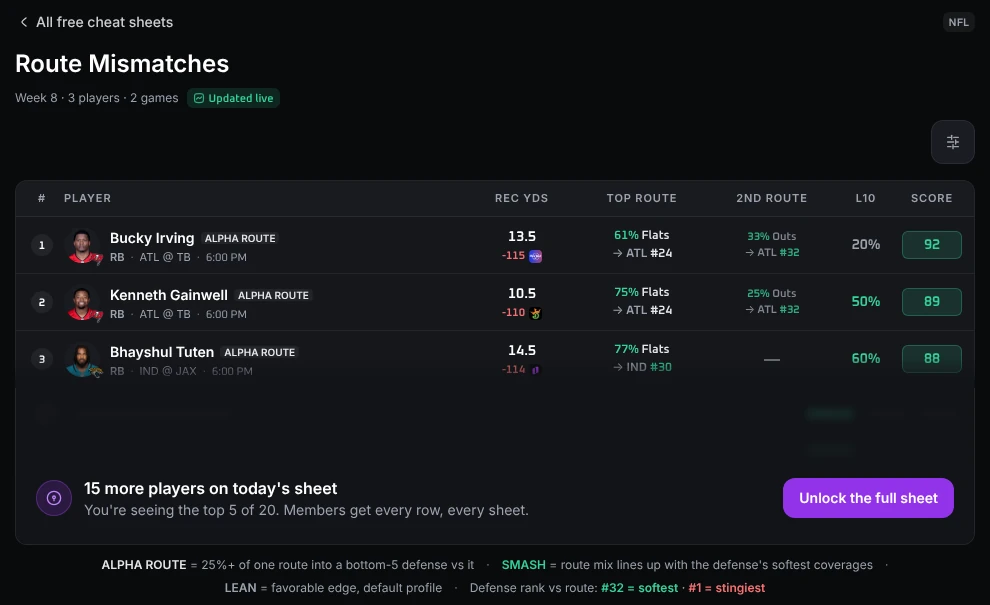
Read a row with the rest of this guide in mind. Bucky Irving tops the Week 8 sheet with a score of 92: most of his routes are flats, and Atlanta ranks 24th of 32 against them, where 32nd is the softest. But he has cleared 13.5 in only 2 of his last 10 games, and -115 needs 53.5% to break even. A good route matchup raises his number; it does not tell you it is now above the line. The matchup is one input, after targets and before price.
Price and shop it
Once you have a number, turn it into a chance at the line and compare it with the price. Two habits matter most on receiving props:
- Shop every book. Receiving lines often differ by a few yards between books, and the chart above shows a few yards is several points of probability. The Line Shopping cheat sheet flags props where one book pays clearly more than the rest, and the line shopping guide explains why beating the closing line is the best long-run sign you are betting well.
- Price alternate lines, do not guess them. An alt over a few yards lower at a shorter price can be better or worse than the main line; the only way to know is to compare each price's break-even with your chance at that number. The EV calculator shows what the edge is worth per bet, and the odds converter turns any price into its break-even.
Hit rates help as a check, not as the case. The Prop Streaks cheat sheet shows how often each player has cleared his current line over the last 5, 10 and 20 games. A long streak at a line that has since moved up says little about the new number.
The routine
- Targets first: his share, the team's expected passes and any news that changes either.
- Turn targets into yards with his catch rate and yards per catch, and think in medians: where does his typical game land?
- Check the matchup at the route level, and his speed against the coverage.
- Compare with the line and the price at every book, including alternate lines.
- Bet only where your chance beats the break-even with room to spare, and stake flat. The bankroll guide covers sizing, and the variance guide explains why a good over still loses to a quiet afternoon.
Doing it in PropsEdge
The free NFL sheets cover each step: Route Mismatches and Speed Mismatches for the matchup, Prop Streaks for each player's record at his line and Line Shopping for the best price. The how to use PropsEdge guide walks through the projections board and player pages, where his game log sits against tonight's line. A PropsEdge membership unlocks every player on every sheet and receiving prices across 15+ sportsbooks.
The average sells the over; the median decides it. Bet what you can afford to lose. If it stops being fun, stop. Help is free and confidential at 1-800-GAMBLER.
Cover photo: Keith Allison, CC BY-SA 2.0, via Wikimedia Commons, color graded.