
The anytime touchdown is the most popular player prop in football, and the one most often bet on a feeling. A back who scored last week, a receiver everyone is talking about, a long price that would be fun to hit. None of that tells you whether the price is right. A touchdown comes from two things you can actually estimate: how many touchdowns the team will score, and how many of them go to this player. This guide walks through both, then the price, as part of our Sport Guides series. The NFL player props guide covers yardage and the other markets.
How the bet works
An anytime touchdown bet wins if the player scores a rushing or receiving touchdown at any point in the game. A quarterback's passing touchdowns do not count for him, but his own runs into the end zone do. Prices usually run from about -200 for a featured goal-line back out to +500 and beyond for depth players. There is rarely a "no" side to bet, so you cannot remove the margin from one book's two prices the way you can on an over/under; comparing the same player across books is how you find the fair number.
Start with the team
A player cannot score touchdowns his team does not score. The sportsbook has already told you how much the team should score: the spread and the total split into an implied score for each side, (total + spread) ÷ 2 for the favorite and (total − spread) ÷ 2 for the underdog. The college football guide works through the same formula. Turn those points into offensive touchdowns, take away the share that goes to field goals, and you have the team's expected touchdowns.
Then estimate the player's share of them, and treat touchdowns as a Poisson count: the chance he scores at least once is 1 − e^(−team TDs × share).
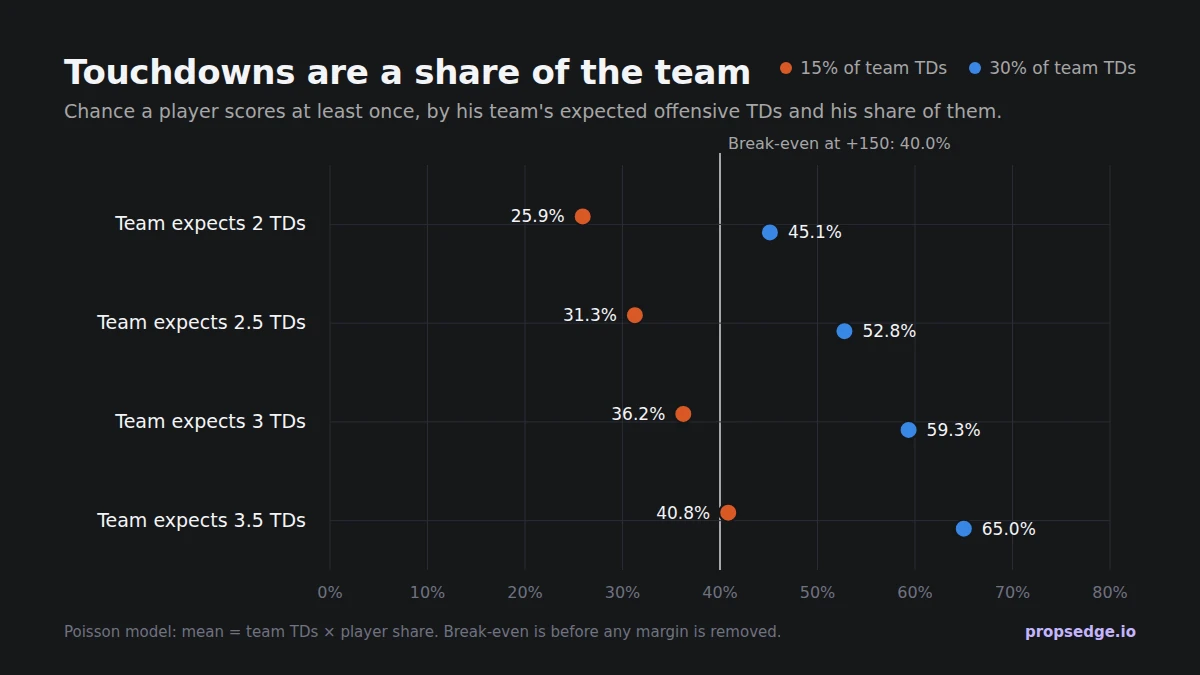
The chart shows how much the team total matters. A player who gets 30% of his team's touchdowns scores in 45.1% of games when his team is expected to score two, and 65.0% when it is expected to score three and a half. The same player, the same role, a very different bet. Before you look at a player, look at the game's total and spread and ask whether this is a week his offense should score.
The red zone decides the share
Most touchdowns are scored from inside the 20, and many from inside the 10. Yardage totals tell you who moves the ball; red-zone usage tells you who finishes drives. Three things to check:
- Red-zone share. His slice of the team's carries and targets inside the 20. A back who gets most of the goal-line carries can out-score a receiver with twice his yardage.
- Inside-the-10 work. The closer to the goal line, the more a carry or target is worth. Goal-line backs and big-bodied receivers and tight ends earn their prices here.
- How often the team gets there. Red-zone trips per game, and how often the opponent lets those trips become touchdowns instead of field goals.
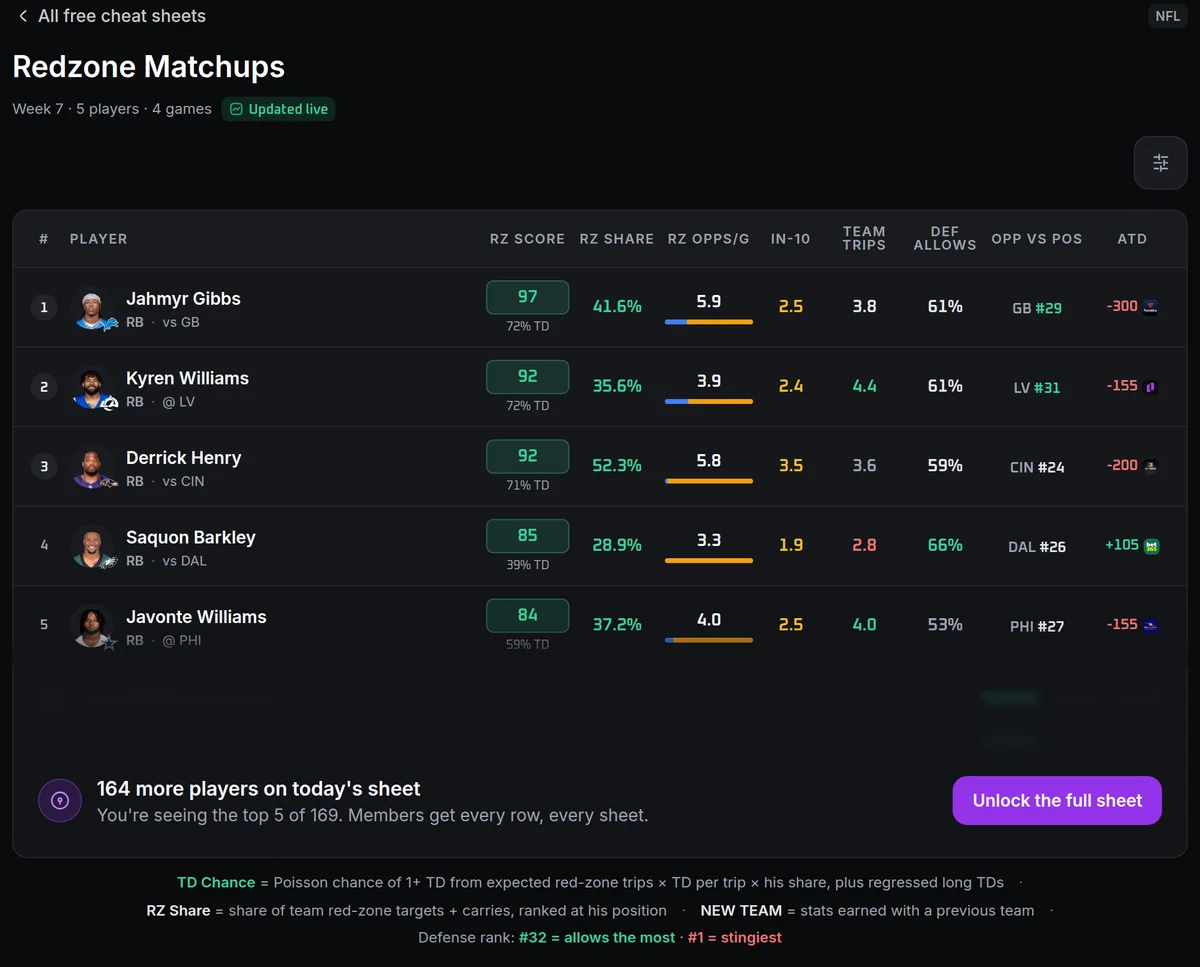
The free Redzone Matchups cheat sheet multiplies exactly those pieces: expected red-zone trips × touchdowns per trip × the player's share, plus a regressed rate for long touchdowns from outside the 20. In the Week 7 rows above, Jahmyr Gibbs and Kyren Williams both come out at a 72% chance to score. Gibbs is priced at -300, which needs 75.0%. Williams is priced at -155, which needs 60.8%. Same modeled chance, very different bets.
What the price needs
Every price implies a break-even chance. Below it the bet loses money over time, however good the player looks.
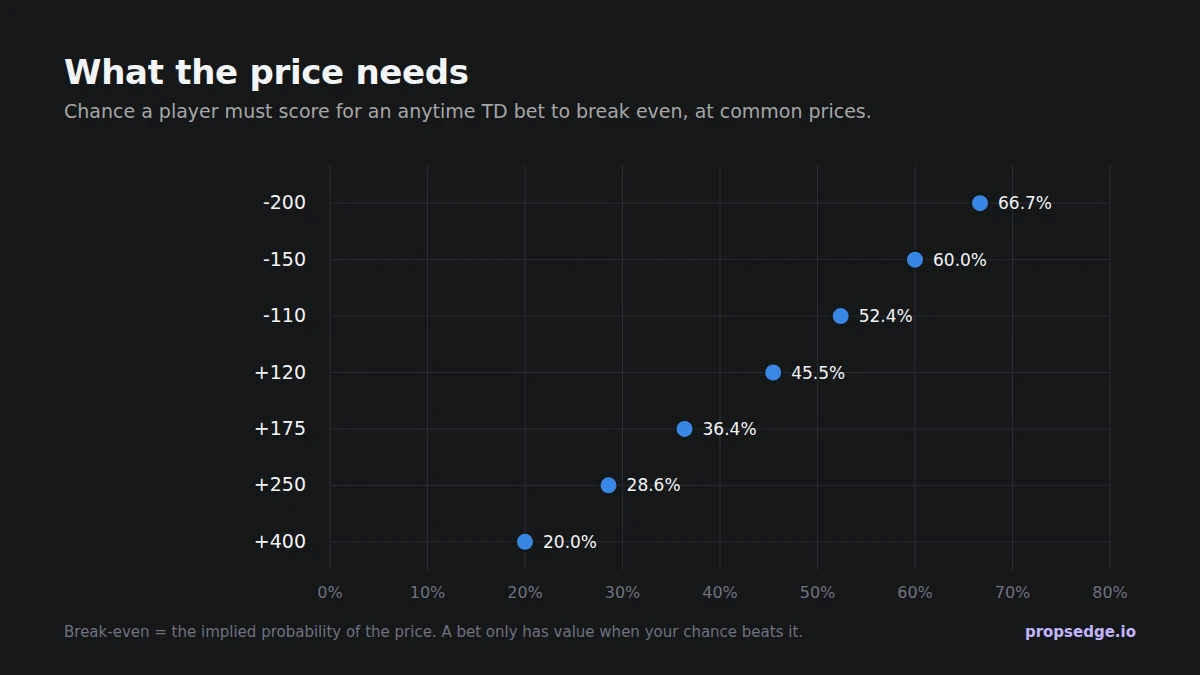
Two things follow:
- Short prices need near-certainty. At -200 a player has to score two games in three just to break even. Even the best goal-line backs miss often enough that a short price rarely leaves room for an edge.
- Shopping is where most of the edge is. Anytime boards carry a large margin, and books disagree. The same player can be +150 at one book and +185 at another, and that gap can be the whole difference between a losing and a winning bet. The line shopping guide explains why, and the EV calculator shows what a given edge is worth per bet.
Hit rates mislead in small samples
"Scored in three straight" is the most common touchdown pitch and the weakest evidence. Touchdowns are rare events, and a handful of games can make an ordinary player look hot or a good one look cold. Use recent scoring as a tiebreaker, not the case:
- Prefer usage to results. Red-zone carries and targets repeat from week to week far better than touchdowns do.
- Use longer windows. Eight games tells you more than three; early in the season, last year's games help.
- Watch for role changes. An injury ahead of a player on the depth chart, or a new goal-line back, changes his share faster than any streak.
First touchdown is a different bet
A first touchdown bet wins only if your player scores the game's first touchdown. Prices run much longer, from about +300 to +5000, because only one player can win it. What matters is the opening script: which offense tends to score on its first drives, and who gets the ball on them. The free First TD cheat sheet shows opening-drive touchdown rates and early touch shares. Treat first touchdown bets as small, long-shot stakes; the variance guide explains why losing runs are normal at those prices.
The routine
- Start with the game: total and spread, and the touchdowns each team should score.
- Find the red-zone roles: who gets the carries and targets inside the 20 and inside the 10.
- Price it: team touchdowns × share gives a chance to score; compare it with the break-even of the price.
- Shop every book and only take prices that clear break-even with room to spare.
- Check the injury report before kickoff; roles move when players sit.
- Stake flat and small. The bankroll guide covers sizing.
Doing it in PropsEdge
The free NFL touchdown sheets cover each step. TD Scorers ranks the slate's anytime bets with a TD score built from the market price, red-zone role, recent TD hit rate, the matchup against the position and touchdowns per game. TD Matchups shows where each defense leaks touchdowns by role and the edge of each player's chance against the best price. Redzone Matchups gives the red-zone share, team trips and modeled TD chance above, and First TD covers the opening script. A PropsEdge membership unlocks every player on every sheet and anytime prices across 15+ sportsbooks.
The touchdown you remember is the one that hit; the edge is in the price you paid for all of them. Bet what you can afford to lose. If it stops being fun, stop. Help is free and confidential at 1-800-GAMBLER.
Cover photo: All-Pro Reels, CC BY-SA 2.0, via Wikimedia Commons, color graded.