
College football has more teams, more mismatches and less information than any league you can bet props on, and that cuts both ways. Sportsbooks post fewer college props, post them later and take smaller bets on them, because they know their numbers are weaker than their NFL numbers. That is where the soft lines come from. It is also where the traps come from: a 30-point favorite's quarterback on the bench by the third quarter, a sack that wipes out 9 rushing yards, a defense that looked elite against an FCS opponent. This guide is part of our Sport Guides series. The NFL player props guide covers the pro game; most of the pricing method carries over, and this guide is about what changes.
Check the rules where you live first. Several states, Ohio among them, ban player props on college athletes at sportsbooks, and pick'em apps limit college props in some states too.
Start with the spread and the total
A player's yardage depends first on how much his team will score and how it will score it. The sportsbook already told you the first part. The total and the spread split into an implied score for each team:
Favorite = (total + spread) ÷ 2. Underdog = (total − spread) ÷ 2.
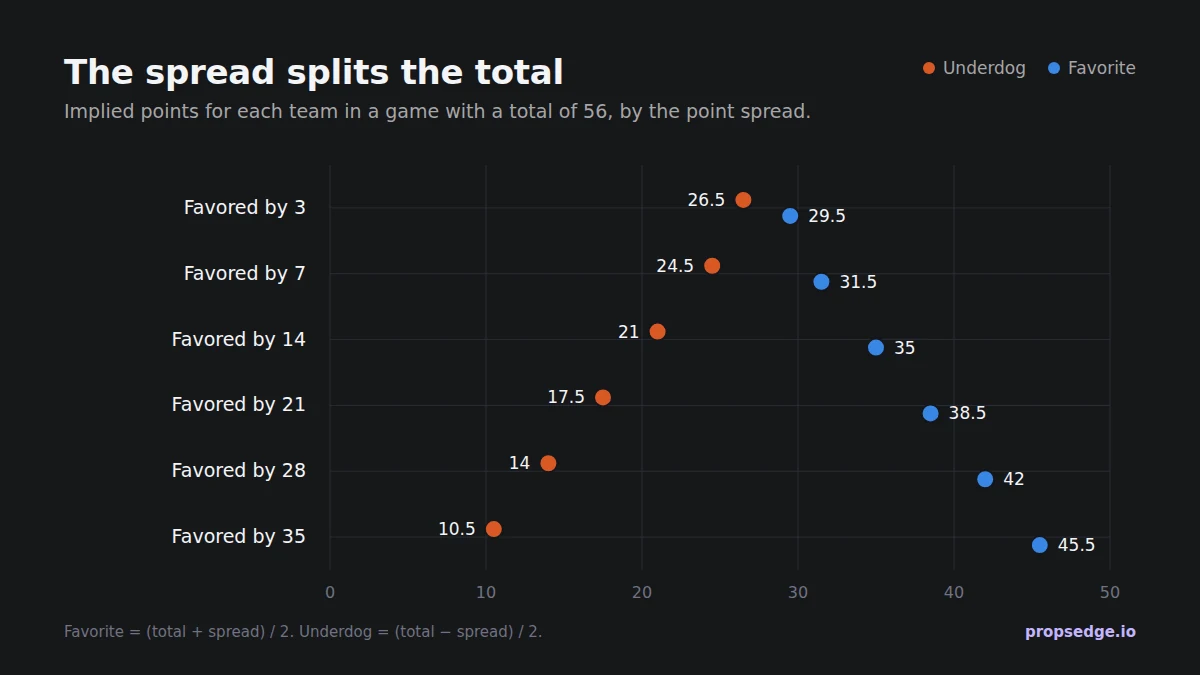
College spreads run far wider than NFL spreads, so the split matters more. In a 56-point game with a 21-point spread, the favorite is expected to score 38.5 and the underdog 17.5. An underdog receiver's over on 70 yards needs a big share of an offense the market expects to score about two touchdowns and a field goal. Compare every yardage line with the team total before anything else: if a running back's line implies a bigger workload than his team's expected points can support, the under is worth a look.
Two other inputs feed volume:
- Tempo. College offenses range from huddle-up, run-first teams to no-huddle offenses that snap the ball every 15 seconds. More snaps means more chances for every stat. Since 2023 the clock keeps running after a first down except in the last two minutes of each half, so games have fewer plays than they did; season averages from older seasons overstate volume.
- Style. Option offenses, such as the service academies', throw far less than most teams. A receiver facing one of them may see fewer drives than his season average suggests, because those offenses keep the ball for long stretches.
Price in the blowout
In the NFL, starters play the whole game unless it is truly lopsided. In college, a four-touchdown lead usually means the backups come in. That changes every prop on the favorite's side, and the market prices it imperfectly.
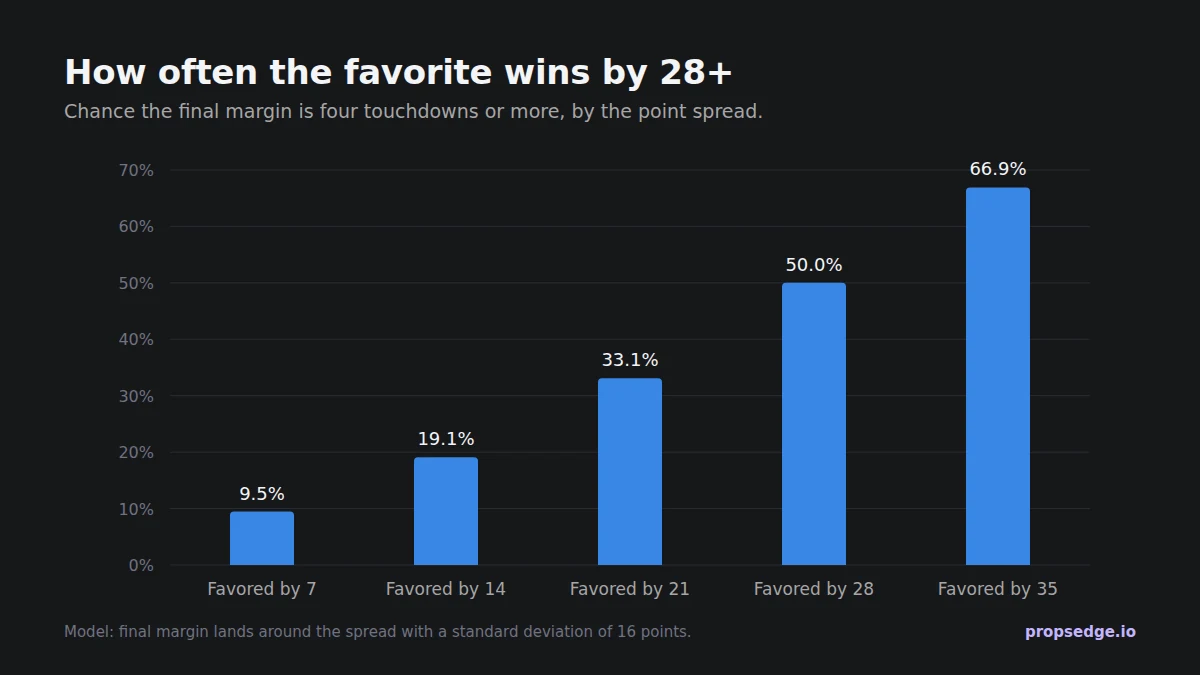
Under a simple model where the final margin lands around the spread with a standard deviation of 16 points, a 28-point favorite wins by four touchdowns or more half the time. In those games its starting quarterback may throw only a few passes after halftime. Books know this and set lower lines on heavy favorites, but they set one number for a range of outcomes: if the game stays close, the starter plays all four quarters and clears the line easily; if it gets out of hand, he sits.
What to do with it:
- Look up how the coach handled the last blowout. Some pull starters at 21 points up in the third quarter, some leave them in for another drive. The player's snap counts or attempts in earlier lopsided wins tell you more than his season average.
- Be careful with long-shot overs on heavy favorites. A 300-yard passing over for a starter on a 30-point favorite needs the game to stay competitive long enough for him to get there.
- The underdog's volume is not automatic. Trailing teams throw more, but a weak offense can also go three-and-out all afternoon. Garbage-time yards against the favorite's backups do count, so an underdog receiver's over can still come in late.
Know the college stat rules
College props settle on official college statistics, and those count some things differently from the NFL:
- Sacks count as rushing yards. In the NFL a sack is charged to team passing. In college it is a rush for the quarterback. A quarterback who gains 52 yards on scrambles and designed runs but is sacked three times for 23 yards finishes with 29 rushing yards. For a running quarterback behind a poor offensive line, the rushing yards over is harder than it looks, and the rushing attempts line includes sacks too.
- Overtime is different. College overtime starts each possession at the opponent's 25-yard line, and from the third overtime teams alternate two-point attempts instead of full possessions. Most books count overtime toward player props; read your book's house rules.
- Combined-stat lines are thinner. Books offer fewer alternate lines and combined props in college, so the line you want may exist at only one or two books.
Adjust matchups for the schedule
Season-long defensive stats lie early in the college season. A team's first few games often include an FCS opponent or a weak non-conference team, and a defense that allowed 90 passing yards to one of those has not proved much. Five games is also a small sample on its own.
When you check how a defense handles a position, weight what it has done against comparable offenses, and look at the last three games as well as the season. The NCAAF Defense vs Position sheet ranks every defense by what it allows to each position over the last 3, 5 and 10 games and the season, which makes a cupcake-inflated number easy to spot. The NCAAF Soft Spots sheet takes the next step and lists the props where a player faces one of the softest defenses against his position in that exact stat.
Price it, then shop it
Thin markets make devigging more important, not less. Fewer books price college props, and a single book's number can be well off the others.
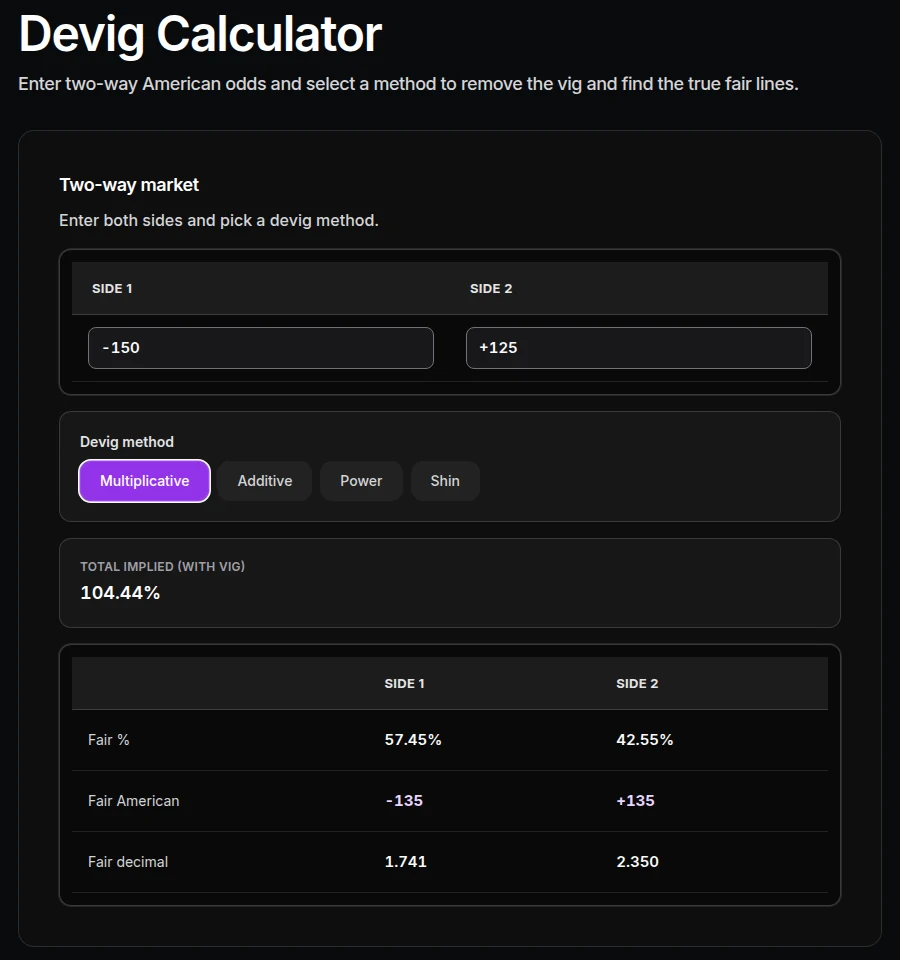
Devig first. A -150 / +125 college prop is a fair 57.45% over, if the books agree on it.
- Find every book's price at the same line and devig each one.
- Trust the number more when three or more books agree. If only one book offers the prop, treat its devigged price as a rough guide, not a fair price.
- Compare the fair probability with what you are being offered. A pick'em line that sits a few yards off the books' main line is where college props are softest, and the NCAAF Line Gaps sheet lists those gaps for every game on the slate.
- If you are betting at a book, take the best price on the board. The NCAAF Line Shopping sheet lists props where one book pays well above the consensus at the same line.
On pick'em apps, the same break-even rules apply as in any sport: each leg has to clear the slip's per-leg rate (see the PrizePicks guide for the table), and the slip optimizer guide explains when an extra leg helps. Demons and goblins are common on college boards; the NCAAF Demons & Goblins sheet shows which ones the books price at the same number.
Information moves the lines
College injury reporting is thinner and less consistent than the NFL's, and depth charts change week to week, especially with transfers who are still settling into a new offense. Starting quarterback news is the biggest single mover. If a backup starts, every passing and receiving prop on that team changes, and books sometimes pull them until they can reprice. Weather matters more in college than you might expect because so many games are played outdoors in November: strong wind cuts passing and kicking far more than rain does.
The first lines posted are the softest and the most likely to move. If your number disagrees with an early line for a good reason, bet it before the market catches up, at a stake you are comfortable with.
The routine
- Implied totals: split the spread and total for both teams.
- Blowout check: for any favorite of 21 or more, look at how the starters were used in earlier blowouts.
- Stat rules: remember sacks in quarterback rushing yards, and check overtime rules.
- Matchup: read the defense's recent games against real opponents, not just the season line.
- Price: devig at the same line, count the books, then shop or find the pick'em gap.
- Stake flat and log every bet with your fair probability. College props reward patience more than volume; a handful of strong bets a week beats twenty thin ones.
Doing it in PropsEdge
PropsEdge covers NCAAF alongside the NFL: projections with the opponent's defensive rank against the position, player pages with game logs and hit rates, and prop insights for each game, all with a PropsEdge membership. Six free college football cheat sheets show the method on this week's slate: Prop Streaks, Line Shopping, Line Gaps, Defense vs Position, Soft Spots and Demons & Goblins. Add any prop to the Pick Builder with + and export the slip to the app or book you play on.
College football props reward the bettor who reads the game before the player. Bet what you can afford to lose. If it stops being fun, stop. Help is free and confidential at 1-800-GAMBLER.
Cover photo: All-Pro Reels, CC BY-SA 2.0, via Wikimedia Commons, color graded.