
An assist is the only stat in the NBA that a player finishes with someone else's shot. He can make the perfect pass and get nothing for it if his teammate misses. So an assists line is two forecasts at once: how many good passes he will make, and how many of those his teammates will knock down. The first one you can forecast. The second is one of the noisiest numbers in the game. This guide is part of our Sport Guides series, alongside the guides to threes and rebounds. The NBA player props guide covers minutes, usage and pace for every stat.
Start with minutes and the ball
As with every counting stat, minutes come first: check the rotation, foul trouble, the spread and rest. For assists, the next question is how much of the offense runs through him while he is on the floor.
- Who else handles the ball. When a team's other main creator is out, the remaining one usually gets more possessions with the ball and more chances to pass. When that player returns, the assists get shared again.
- Who he passes to. If the team's best scorer is out, he still makes passes, but fewer of them go to a player likely to score. That cuts the other way from the first point, so check both.
- Pace and the total. More possessions mean more passes that lead to shots. A high total and two fast teams help the over.
Potential assists, then teammates
The best single number for an assists prop is his potential assists: passes that led to a shot that would have been an assist if it went in. They measure the part he controls. His actual assists are his potential assists times the share his teammates made.
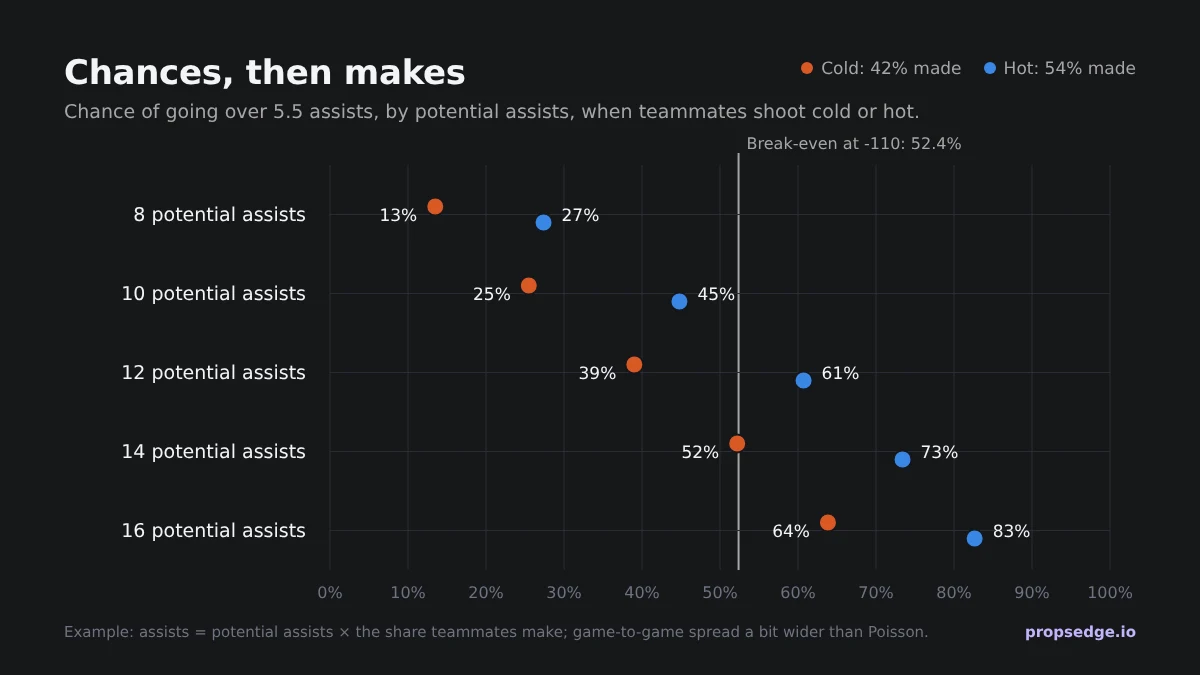
For a passer with 12 potential assists, the over 5.5 hits about 39% of the time on a night his teammates make 42% of those shots, and about 61% of the time on a night they make 54%. That gap is bigger than the difference between 10 and 12 potential assists. It also means a low assist total after a good passing game is usually the shooters, not the passer. A player who had 14 potential assists and only 4 assists is likely to bounce back; one who had 7 potential assists and 7 assists got lucky.
The PropsEdge player page shows this for every game: on an assists chart, the grey "chances" overlay shows his potential assists under the bar of assists he got. Look at the overlay before you trust a hot or cold run.
How a normal game looks
Assists swing a lot for the same player. For a passer projected at 6.8 assists, he finishes with 4 or fewer about 22% of the time and 10 or more about 17% of the time. Both are ordinary games.
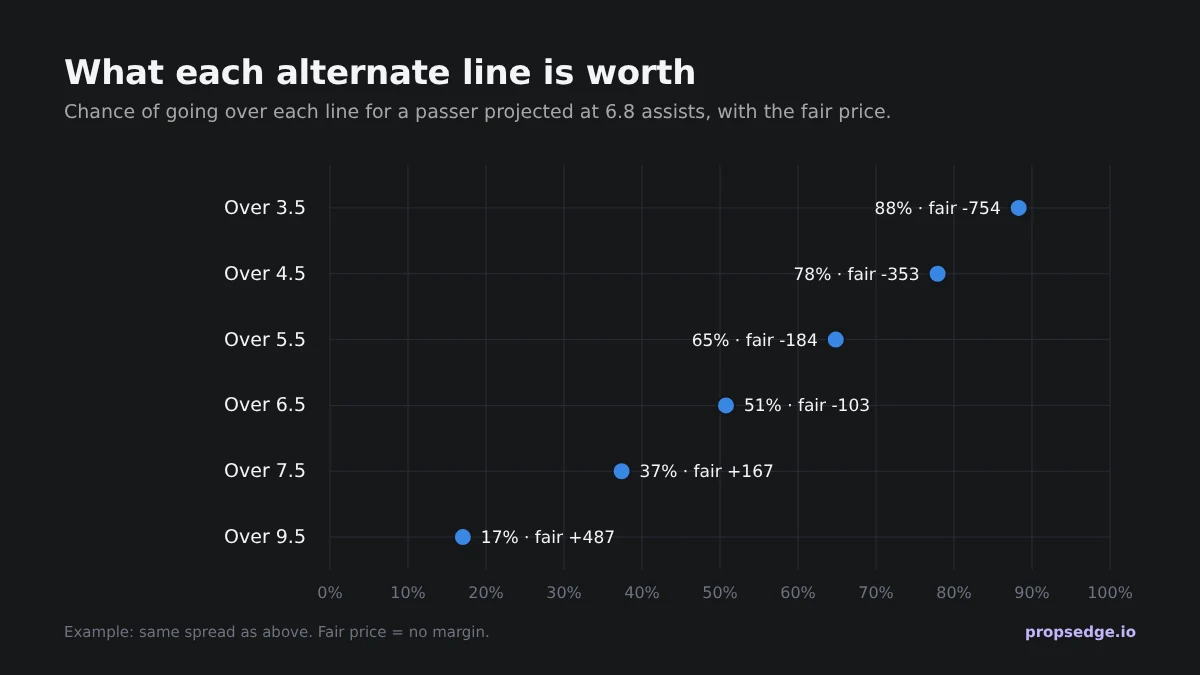
Price every rung from the same projection. For this passer, over 5.5 is fair at -184 and over 6.5 at -103, so a book that hangs 6.5 at -110 is a little worse than fair, while one that hangs 5.5 at -150 is giving you value. At the top of the ladder, over 9.5 is fair at +487. Alternate lines carry their own margins, so compare each one with the fair price. The odds converter turns any price into its implied chance, and the EV calculator shows what the gap is worth.
On pick'em apps a pick on a two-pick PrizePicks Power play needs to hit about 57.7% of the time to break even, more than a -110 bet's 52.4%. A line at 5.5 for this passer, at 65%, clears that; a line at 6.5 does not.
How an assist is counted
- The pass has to lead directly to a made basket. A pass that leads to free throws is not an assist, even if the shooter was fouled on a layup he would have made. Neither is the pass before the assist.
- The official scorer decides. If the shooter takes several dribbles or beats his man after the catch, the scorer may not credit an assist. Scoring varies a little between arenas.
- Overtime usually counts, and if he is ruled out before the game the bet is usually void. Rules differ by book, so check yours.
The matchup, on the sheet
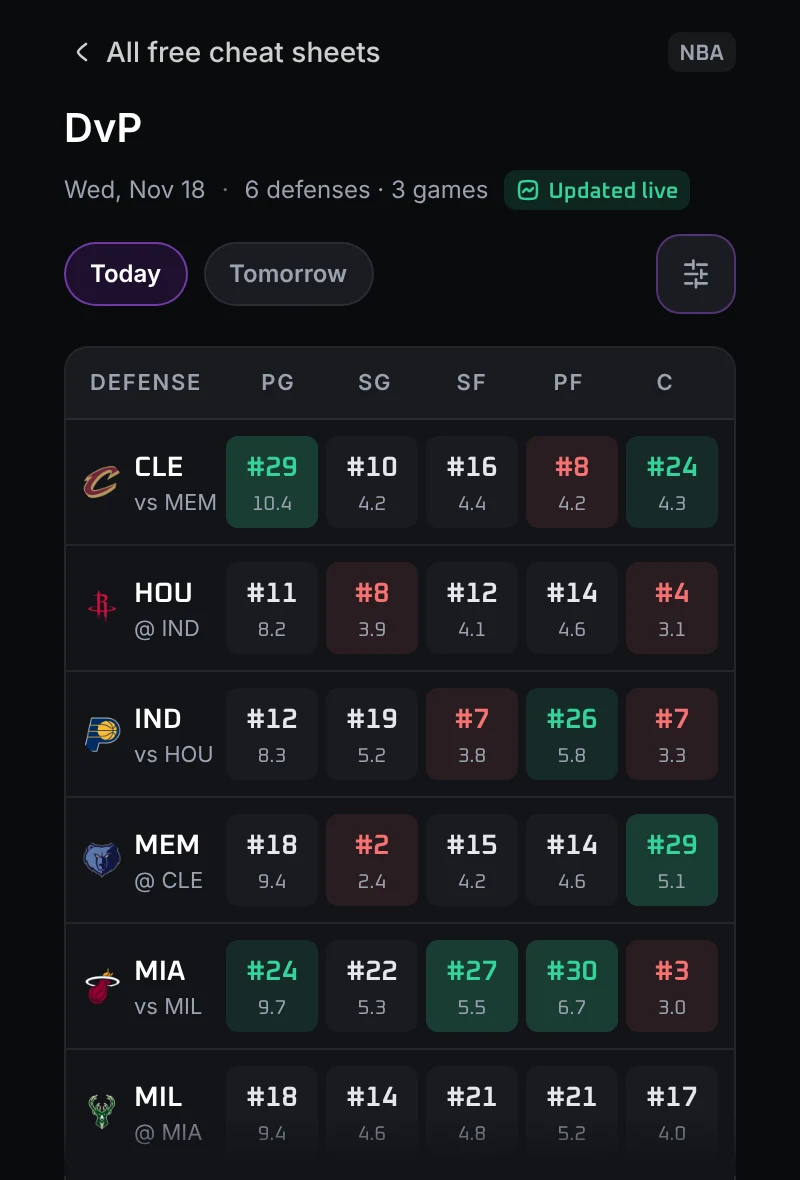
The free NBA Defense vs Position sheet shows what each defense allows to each position, by stat and window. With assists selected for today's games, Cleveland has allowed 10.4 assists a game to point guards, second-most in the league. Treat it as a nudge, not a bet: assists allowed depend on how well the point guards' teammates shot against that defense, which is the noisy part.
- Shop the line. Books often post different assist lines for the same player. The free NBA Line Shopping sheet flags props where one book is paying meaningfully more than the rest, and the devig calculator strips the margin from a two-sided price.
- Shortlists. The free NBA Soft Spots sheet lines posted props up against the softest defenses for that position and stat, and NBA Prop Streaks shows who has cleared his current line most often lately. Both are places to start, not bets.
The routine
- Minutes and the ball, from the rotation, injuries to other creators and scorers, pace and the total.
- Potential assists, his recent level, checked against the overlay rather than his assist totals.
- A make rate you can defend for his teammates, not last week's.
- Projection to probability at every line, then price, shopped across books.
- Stake flat. The bankroll guide covers sizing, and the variance guide explains why good bets still lose often.
Doing it in PropsEdge
The projections board shows every player's assists line with our projection, the line movement and the best price across sportsbooks, and the player page's assists chart shows his potential assists game by game. The free NBA cheat sheets above cover the matchup, the streaks and the price. A PropsEdge membership unlocks every row of every sheet.
An assist depends on someone else's shot, so bet the passes, not the makes. Bet what you can afford to lose. If it stops being fun, stop. Help is free and confidential at 1-800-GAMBLER.
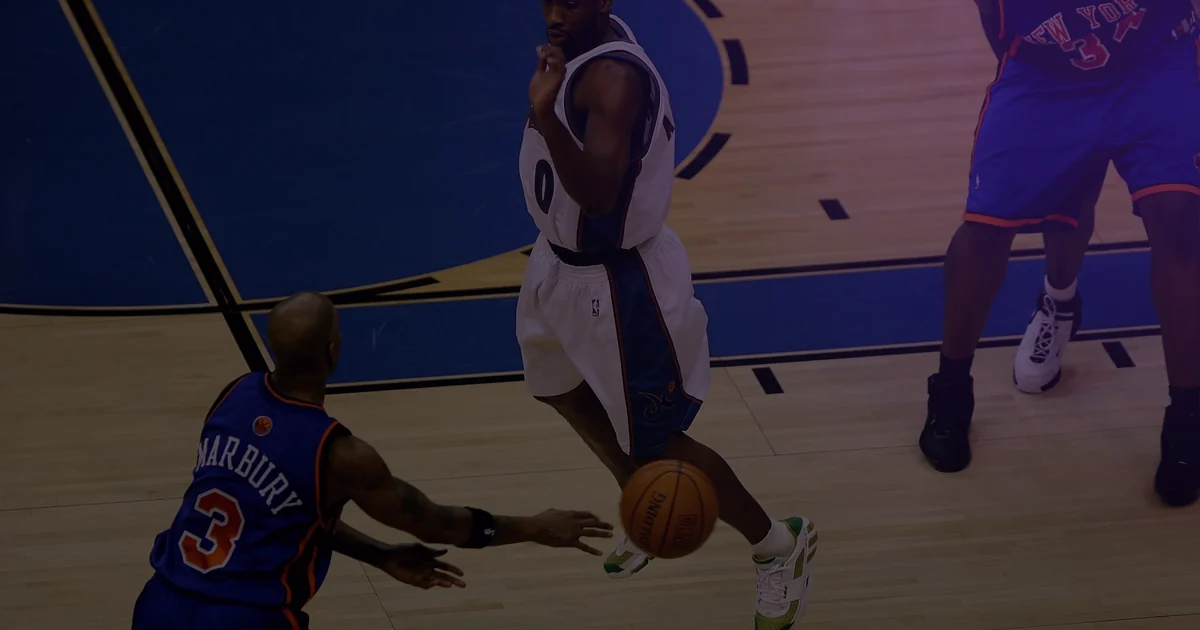
Cover photo: Stephon Marbury passing against Washington. Keith Allison, CC BY-SA 2.0, via Wikimedia Commons, cropped and color graded.