
College basketball tips off with 365 Division I teams, a schedule full of mismatches and a betting market that has barely started paying attention. On opening night, Monday, November 2, the free NCAAB Prop Streaks cheat sheet listed 80 player props across 13 games. Only 6 of them had a sportsbook price; the other 74 were posted only on pick'em apps. That is what college player props look like in November: thin markets, soft numbers and a lot of guesswork on both sides. This guide is part of our Sport Guides series. The NBA player props guide covers the pro game and most of its method carries over; this guide is about what changes in college.
Check the rules where you live first. Several states, Ohio among them, ban player props on college athletes at sportsbooks, and pick'em apps limit college props in some states too.
Start with minutes, and the rules that cut them
Every counting stat is a rate times minutes. College changes both halves of that.
- The game is 40 minutes, two 20-minute halves, against 48 in the NBA. A starter who plays 32 minutes is on the floor for 80% of the game, but there are fewer minutes to go around and benches are deeper early in the season while coaches sort out rotations.
- Five fouls and you are out, not six. Many coaches sit a starter who picks up two fouls in the first half, so a big man who fouls a lot can lose ten minutes before he ever gets near the limit. Check how often he has been in foul trouble, and who guards him tonight: a post scorer who draws fouls is a problem for every center he faces.
- The shot clock is 30 seconds, resetting to 20 when a shot hits the rim and the offense keeps the ball. Teams still choose how fast to play, and the gap between the fastest and slowest teams is wide. Pace decides how many chances every player gets. The NCAAB betting basics guide explains possessions and efficiency in detail.
So the first question for any prop is the same as in the NBA: how many minutes will he play tonight, and is anything about this game likely to change that?
Price in the blowout from the spread
The biggest single difference from the NBA is how lopsided college games get. In November, power-conference teams schedule home games against small-conference opponents, and spreads of 20 points or more are common. When a game is decided early, starters sit, and every over on a starter's points, rebounds or assists loses the minutes it needed.
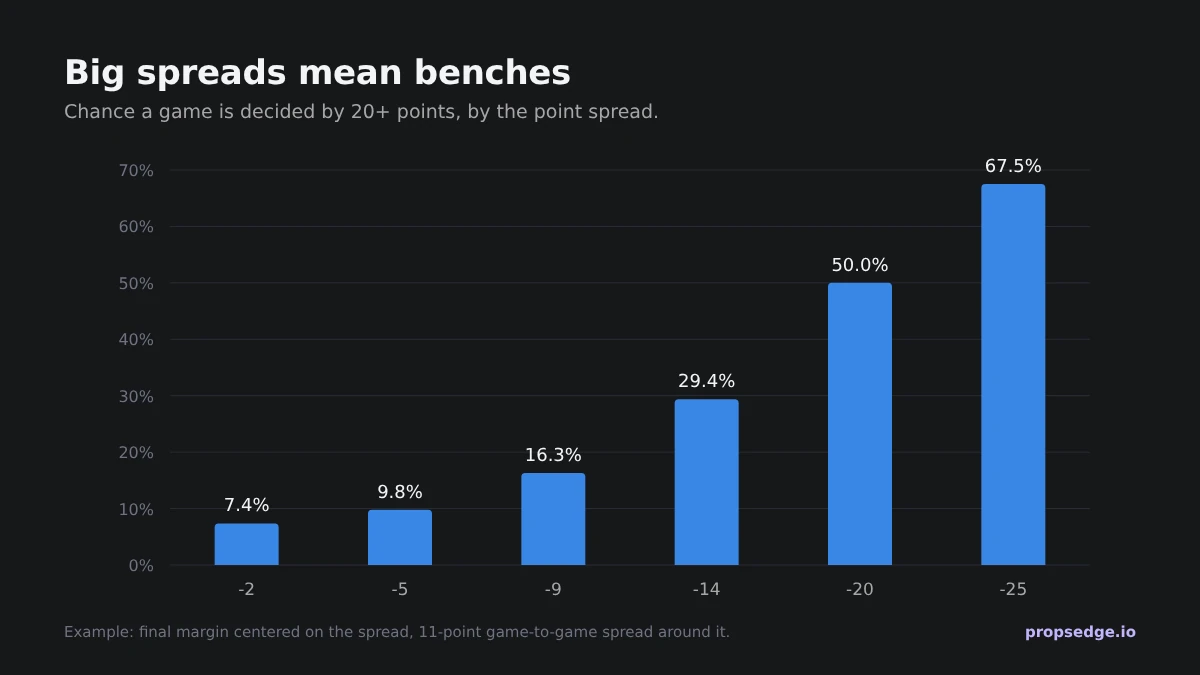
The spread tells you how likely that is. If the final margin lands around the spread with a typical miss of about 11 points either way, a 14-point favorite wins by 20 or more about 29% of the time, and a 25-point favorite about two times in three. In those games the starters on both sides play less, and the reserves who usually play five minutes get fifteen.
Three things follow:
- A starter's over in a big mismatch needs more than the usual edge. His per-minute numbers may look great against a weak opponent, but he may not be on the floor in the second half to use them.
- The underdog's best player is the exception. A small-conference star often plays almost every minute and takes a huge share of his team's shots, win or lose. His minutes are safer than the favorite's starters'.
- Check the total too. The total and the spread split into an expected score for each team: favorite = (total + spread) ÷ 2, underdog = (total − spread) ÷ 2. A 145 total with a 21-point spread puts the underdog at 62. A player whose points line is a big share of that number has to carry an offense the market expects to struggle.
Early-season numbers are mostly noise
In the first weeks you are pricing players on two or three college games, and those games were often against the weakest opponents on the schedule.
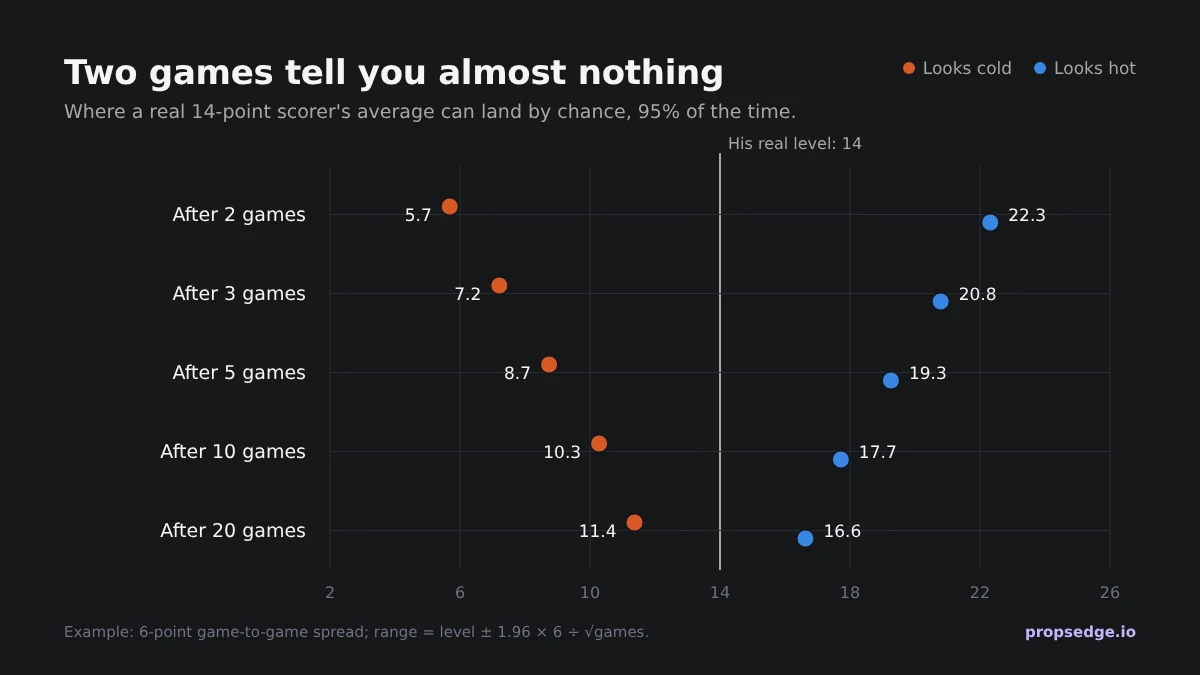
A player who really scores 14 a game, with a normal game-to-game spread of about 6 points, can average anything from about 6 to 22 over his first two games just by chance. After ten games the range is still about 10 to 18. A hot start against a cupcake schedule is not information you should pay for; markets can overreact to it, and when they do the value sits on the other side.
What to use instead:
- Last season, adjusted for the new role. Rosters turn over heavily through the transfer portal. A guard who averaged 18 as the first option at a small school may be the third option at a power-conference team, with fewer shots against better defenders. Start from his per-minute numbers, then ask what his new role and minutes will be.
- Who left. If a team lost its two leading scorers, those shots go somewhere. The returning players and the new arrivals who take over those roles are where the early numbers move most.
- Freshmen have no college history. Lines on highly recruited freshmen are often built on reputation. Their minutes in the first few games tell you more than their points do.
Streak records need the same care. On opening night every "last 10 games" record comes from last season, sometimes from a different team. Read a 10-for-10 under as a question about whether his role has changed, not as a reason to bet.
Matchups: guards, forwards and centers
College matchup data is thinner than the NBA's, for two reasons. Teams play only about 30 regular-season games, many of them against opponents far weaker or stronger than average, and positions are broad. The free NCAAB Defense vs Position sheet groups players as guards, forwards and centers and shows what each defense has allowed to each group.
Use it the way the NBA defense vs position guide explains, with extra caution:
- Look at who the defense has played. Allowing 30 points a game to guards means little if two of those games were against teams in the top 25.
- Shrink extreme numbers toward the average. Over three or five games, a perfectly average defense can look terrible by chance.
- Size and style matter more than in the pros. A team without a true center may give up big rebounding nights; a slow, physical team may hold guards down by keeping the game short. Ask why a defense is soft before you count on it.
The free NCAAB Soft Spots sheet lines posted props up against the softest defenses for that position and stat. It is a good shortlist, not a list of bets.
When only the pick'em apps post a line
Sportsbooks post fewer college props, post them later and take smaller bets on them. On most college games the only lines you will find are on pick'em apps such as PrizePicks and Underdog, which means there is often no sportsbook price to compare against.
That changes how you check a line:
- Without a sportsbook price there is nothing to devig, so the devig calculator cannot give you a fair probability. You need your own projection: expected minutes times his per-minute rate, adjusted for pace and the matchup.
- Know your break-even. A pick on a two-pick PrizePicks Power play has to hit about 57.7% of the time to break even, more than the 52.4% a -110 sportsbook bet needs. The pick'em payouts guide has the numbers for every slip.
- When books do post the prop, compare. The free NCAAB Line Gaps sheet flags pick'em lines sitting well off the market, and the NCAAB Line Shopping sheet shows where one book pays more than the rest. The NCAAB Demons & Goblins sheet checks PrizePicks' alternate lines against the books.
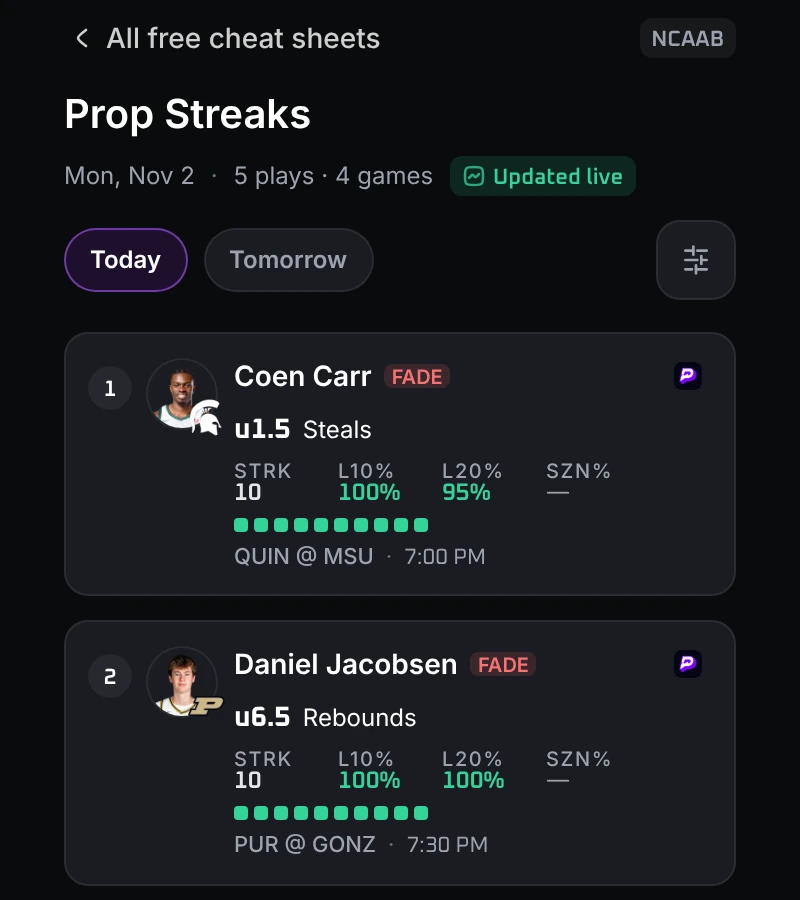
The free NCAAB Prop Streaks sheet shows how often each player has cleared tonight's line over his last 5, 10 and 20 games. On opening night the season column was empty for everyone, every record came from last season, and 67 of the sheet's 80 rows were unders. Those lines went up before anyone had seen the new rosters play, which is exactly when you should ask whether the role, the minutes and the team around each player have changed.
The routine
- Minutes first. Expected minutes from his role, his foul habits and the spread.
- Blowout risk. The bigger the spread, the more a starter's over needs.
- The right sample. Last season adjusted for his new role, not two games against weak opponents.
- The matchup, with the opponent's schedule in mind and extreme numbers shrunk.
- The price. Compare books when they post the prop; otherwise compare your projection with the app's break-even.
- Stake small and flat. College props are thin and volatile. The bankroll guide covers sizing, and the variance guide explains why good bets still lose often.
Doing it in PropsEdge
College basketball is on the projections board with the rest of the leagues, and the six free NCAAB cheat sheets above cover each step, from each player's record at his line to the softest matchups and the best price. All of them are in the cheat sheets hub. A PropsEdge membership unlocks every row of every sheet.
College props are a small, thin market. Bet what you can afford to lose. If it stops being fun, stop. Help is free and confidential at 1-800-GAMBLER.
Cover photo: Saint Joseph's at Princeton, men's basketball, 2018. Jonathan Schilling, CC BY-SA 4.0, via Wikimedia Commons, cropped and color graded.